 Collectors Tools
A graded full ticket is not always a ticket anyone could enter with
The market pays more for a full ticket than a stub, but 'full ticket' hides very different objects: genuine seated entry tickets, printer's proofs, and press, media, photo and TV passes that never admitted anyone. Messi's Argentina debut shows the problem, sixteen graded fulls and only one a real stadium-entry ticket.
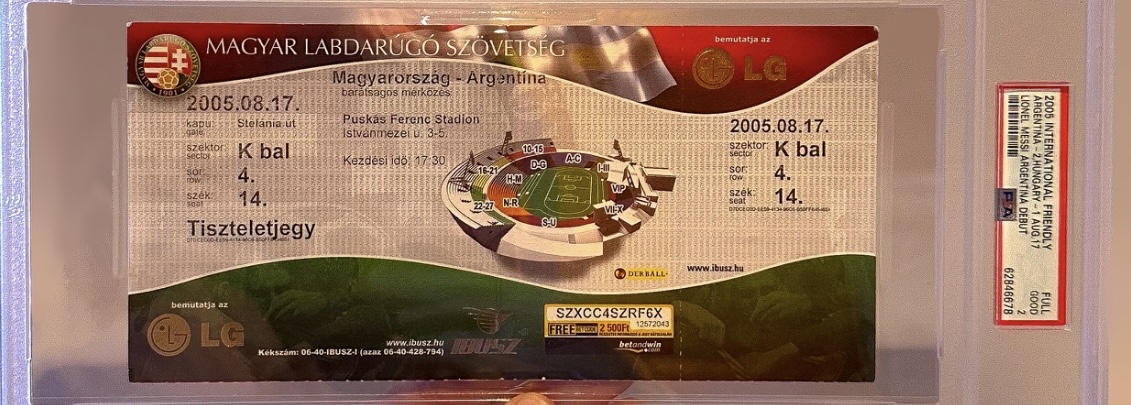
The first rule of ticket collecting is that a full ticket beats a stub. Hold the same game at the same grade and the full sells for about double the stub, and far more for vintage games. The rule is real, but it rests on an assumption nobody states: that a "full ticket" means the whole, unused, never-torn ticket a fan would have handed over at the gate. For a surprising share of the market, that assumption is wrong. Many graded fulls were never entry tickets at all, and telling them apart is one of the hardest valuation problems in the hobby.
The figures below come from the 75,903 PSA-graded tickets we track on the population database and the sales we aggregate across Goldin, Heritage and Fanatics Collect. The Messi populations were read live from PSA's report this week (as of June 29, 2026), combining every variation, full and stub. The point of this post is not the full-versus-stub price gap, which we covered separately; it is what the word "full" is actually describing.
Not every full ticket admitted anyone
A stadium prints more than entry tickets. It prints printer's proofs (test sheets that never went on sale), press and media passes, photographer's tickets, and TV/broadcast credentials. None of these is the ticket a paying fan used to walk in, yet all of them are intact, un-torn pieces of paper, so all of them get graded and listed as "full tickets." In our data there are at least 1,300 such non-entry tickets: about 562 proofs, 428 press passes, 191 media tickets, 82 photo tickets and 60 TV credentials. For an ordinary game they are a curiosity. For a famous debut they quietly become most of the "full" supply.
Messi's Argentina debut: sixteen fulls, one entry ticket
The cleanest example is the ticket in the image above. On August 17, 2005, an 18-year-old Lionel Messi made his senior debut for Argentina against Hungary in Budapest, came on as a substitute, and was sent off within minutes. PSA has graded 16 full tickets and 10 stubs of that match. But of the 16 fulls, only one is a standard seated stadium-entry ticket: the PSA GOOD 2 example shown here, printed with a real sector (K bal), row (4) and seat (14). Every other graded full is a media, photo or TV ticket. The cert page confirms the shape of it: this exact seated ticket reads population 1 at its grade with 15 graded higher, and those 15 are the non-entry variants.
That is the valuation problem in a single game. A buyer searching "Messi Argentina debut full ticket" sees lots that have sold from $1,650 to $6,720, but the listings do not all describe the same object. A graded full at $2,684 might be a press or photo ticket; the genuine seated ticket a fan used to watch Messi's first Argentina appearance is a different, scarcer thing entirely, and the market has no clean mechanism to separate them. When the supply of "fulls" is mostly non-entry paper, the rule that a full beats a stub stops being a safe shortcut.
Which is why a stub is sometimes the honest buy
A stub has one quality a pristine full can lack: it proves the ticket was used. It was torn at the turnstile, which means a person carried it through the gate to watch the game. A flawless full might be exactly that, an unused survivor, or it might be a proof, a comp, or a credential that never saw the event. For collectors who care that their ticket actually attended the moment, the stub is the stronger provenance, not the weaker one.
How to read a full before you pay full price
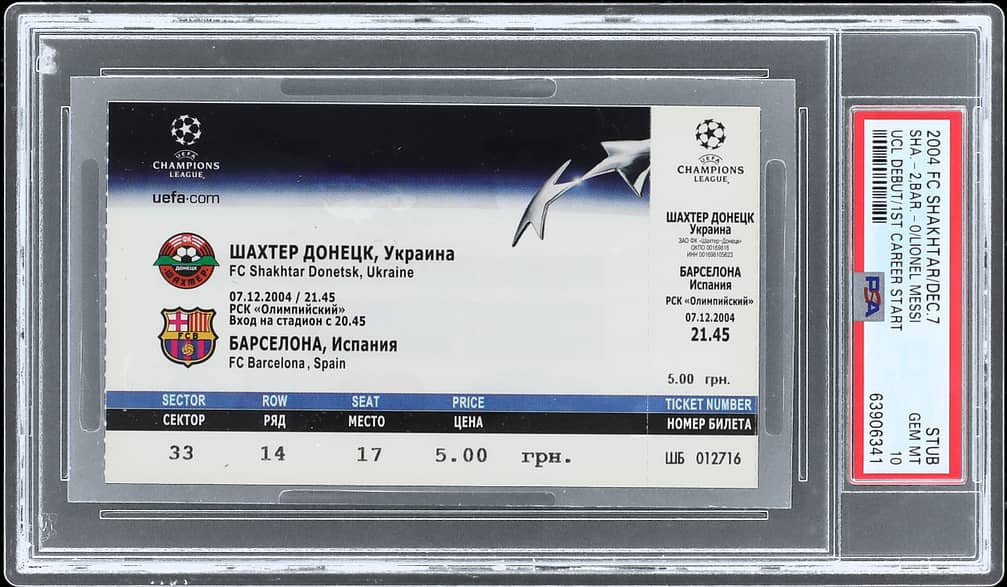
The full-over-stub premium is still right when you are comparing like for like, and the asymmetry behind it is permanent: you can always turn a full into a stub, never the reverse, and an intact ticket has the better eye appeal. But before paying the premium, read the ticket itself. A seat assignment (section, row, seat) is the signature of a genuine entry ticket. Words like proof, press, media, photo, complimentary or TV, or the absence of any seat, mark a ticket that was never sold to a fan. For older games a true seated entry full is genuinely scarce, because almost all were torn at the gate; only since stadiums went digital have unripped entry fulls become common, the shift we traced in why modern tickets grade like cards.
"Full ticket" is a description of a ticket's condition, not its purpose, and the two come apart exactly where the money is. For the most collectible debuts and milestones, the intact paper on the market is often a proof or a credential, while the one ticket a fan carried through the gate is a stub, or, as with Messi's Argentina debut, a single seated full hiding among fifteen that never admitted anyone. Pay for the object you actually want, not the word in the title.
Explore the data behind this report
Search every graded ticket sale, browse PSA population data, and track sold prices on Collectors Tools.