 Collectors Tools
Full ticket vs stub sells for about double at the same grade, and up to 15x on vintage games
Match the same game at the same grade and a full ticket sells for about double the stub, and up to 15x for vintage games where intact fulls barely survived.
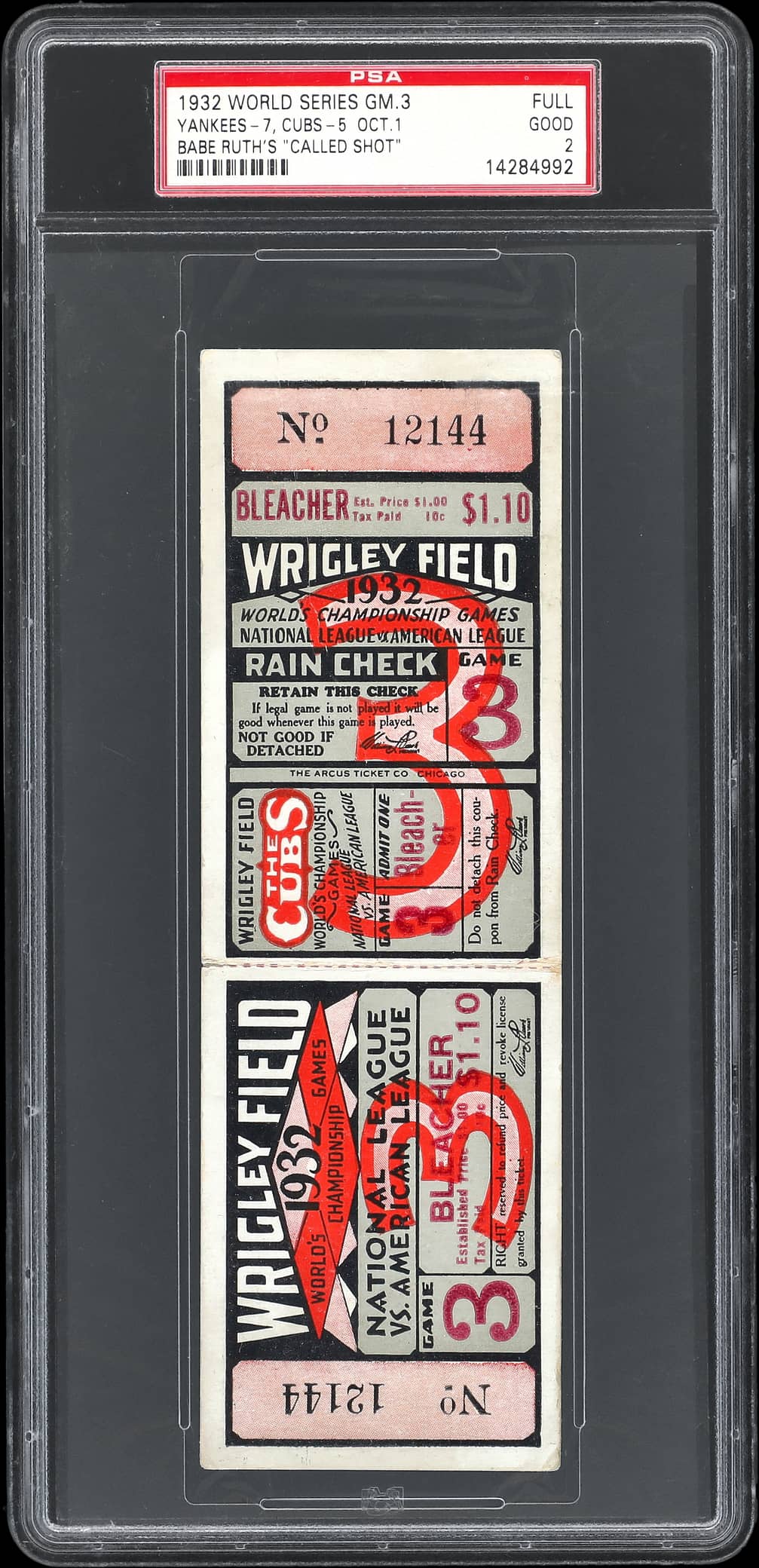
Full ticket vs stub is the most common question in graded tickets. We ran it across 14,747 graded full and stub sales. The answer: hold the same game at the same grade and a full ticket sells for about double the stub (median 1.95x), winning 72% of matchups, and up to 15x for vintage games where intact fulls barely survived.
Every figure here is a realised sale from public.sales, our auction archive across Heritage, Goldin and Fanatics Collect, 2004 to June 2026. We classified each lot as a full ticket or a stub from its title, kept only graded sales (PSA, BGS, SGC), and dropped autographed lots so a signature premium never contaminates the comparison. Where a sale carries a PSA cert you can open the slab on our ticket scan database.
Match the same game and the full wins ~2 to 1
The fair test holds the event constant: compare a full and a stub of the exact same game. Across 278 matched games, the full sold for a median 1.98x the stub; restrict it further to the same grade as well and it is 1.95x across 83 clean pairs. Tighten it again to fulls and stubs sold within two years of each other and it holds at 2.00x, so this is not a market-timing artifact: the premium survives the 2021 boom, the 2022-23 cooldown and the 2026 rebound alike. In 72% of matched games, the full sold higher.
The gap is widest for vintage games
Because the premium is a scarcity story, it tracks how few fulls survived, and that is an age curve. Group every matched game by the decade it was played and the full premium runs 3.2x in the 1920s and 3.2x in the 1960s, settling to 1.8x in the 1990s and 1.6x in the 2000s. Modern fulls exist in quantity (people keep unused tickets now), so the gap narrows. For pre-war and mid-century games, an intact full is close to unobtainable, and the multiple balloons.
Super Bowl I: the same game, full vs stub, grade by grade
The cleanest illustration is Super Bowl I (1967). Hold the grade and the full is worth 3.5x to 5x the stub at every level: PSA 4 full $14,815 vs stub $2,880, PSA 3 $9,150 vs $1,800, even at the lowest PSA Authentic tier $2,700 vs $762. Same game, same grade, the only variable is whether the ticket was torn.
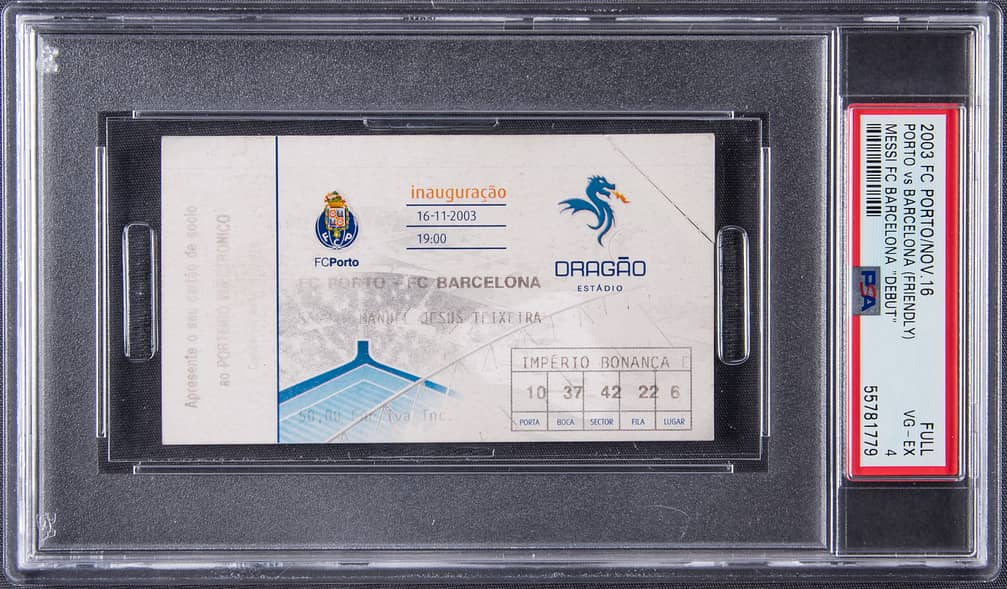
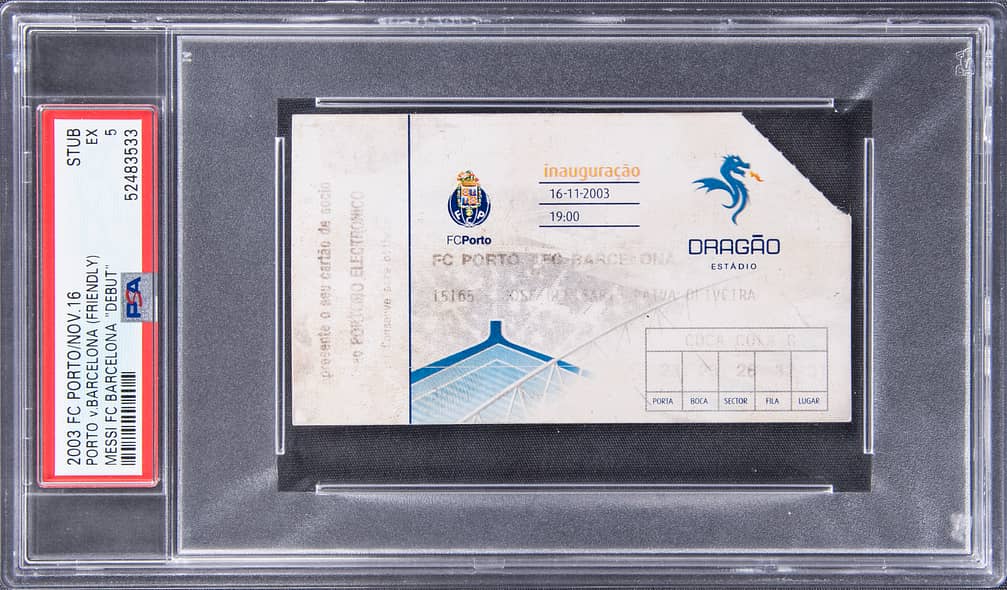
Full ticket vs stub across the decades
Same game, same grade, full vs stub, spanning the eras. The pattern holds top to bottom: the older and scarcer the surviving full, the larger the premium. The 1979 NCAA Final (Bird vs Magic) full goes for 15x the stub at Authentic; the modern Messi debut is 1.2x. The standout single sale is the 1984 Michael Jordan NBA debut full at $468,000, the only known example, against roughly $18,000 for an Authentic stub of the same game.
| Game | Grade | Full | Stub | Full premium |
|---|---|---|---|---|
| 1979 NCAA Final, Bird vs Magic | GradePSA Auth | Full$6,405 | Stub$421 | Full premium15.2x |
| 1958 NFL Championship "Greatest Game" | GradePSA Auth | Full$7,320 | Stub$858 | Full premium8.5x |
| 1967 Super Bowl I | GradePSA Auth | Full$2,700 | Stub$762 | Full premium3.5x |
| 1941 Lou Gehrig Memorial | GradePSA Auth | Full$1,140 | Stub$462 | Full premium2.5x |
| 1969 "Miracle Mets" World Series | GradePSA 5 | Full$600 | Stub$330 | Full premium1.8x |
| 2003 Messi Barcelona debut | GradePSA 5 | Full$517 | Stub$421 | Full premium1.2x |
One famous outlier cuts the other way. The 1932 Babe Ruth "Called Shot" full ticket (World Series Game 3) has sold from $48,000 to $75,030, far above any stub of the game, but a handful of low-grade fulls have changed hands cheaply, so a single-grade median can read low. It is a reminder that these are medians, not laws: condition, variation and timing all move an individual lot.
Matching the same game at the same grade settles it: a full ticket is worth about double the stub, 2-5x for vintage games, narrowing toward parity only for modern tickets that survived intact in quantity. For tickets, the moment prices the paper, and the full is simply the scarcer half of it.
Explore the data behind this report
Search every graded ticket sale, browse PSA population data, and track sold prices on Collectors Tools.