 Collectors Tools
Modern graded tickets are starting to behave like trading cards
Vintage tickets are priced by survival, so the lowest grades cost the most. Modern graded tickets flip that: stadiums went digital, stubs disappeared, full tickets and PSA 10s are everywhere, and price is moving onto the gem tier and the variation, the way it already works for cards.
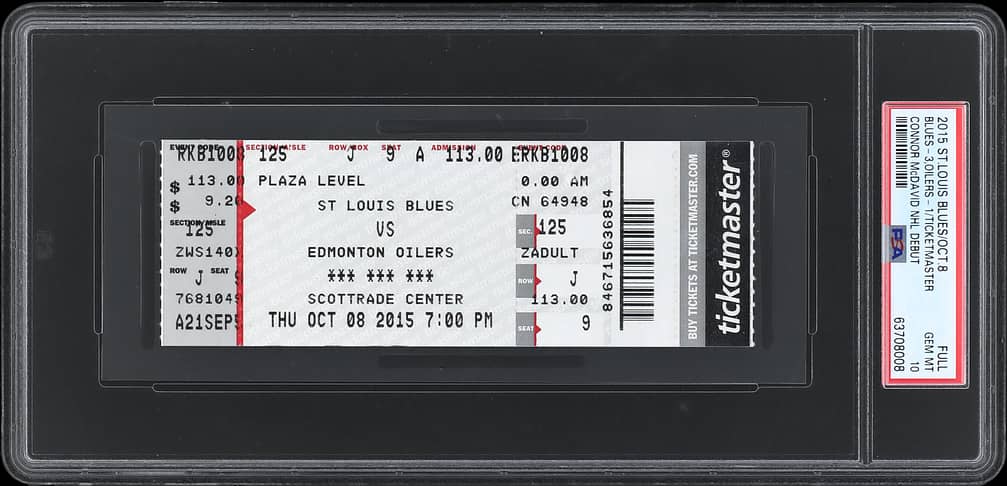
There are two graded-ticket markets, and they obey opposite rules. The vintage one runs on survival: a clean ticket from a historic game can barely exist, so the few that do are worth the most and the grade is really just a measure of age. The modern one runs on the same logic as trading cards. Since stadiums went digital, the paper ticket is no longer torn at the gate, so it survives intact and in top condition by default, and once a PSA 10 is common the price stops rewarding survival and starts rewarding the two things that are still scarce: the gem-mint tier, and the variation. This post is about where that second market begins and how it prices.
The data: every condition figure now comes from our full PSA population census of 8 July 2026, PSA's own per-grade counts across 229,460 graded tickets on the population database, grouped by the year of the event. This post originally used our scan reference, a sample of that population; the census replaces it because it counts every graded copy rather than the ones we hold, and it reads modern gem-mint rates several points higher as a result. Every price figure is a realised sale from public.sales, our archive of graded-ticket results across Goldin, Heritage and Fanatics Collect, 2013 to June 2026, with bulk lots removed so one price means one ticket. "Modern" means an event from 2015 onward, "vintage" before 1980. Individual population figures (the McDavid and Ohtani lots below) were read live from the PSA cert pages in June 2026. You can open any cert on the ticket scan database.
The stub disappeared, and the full ticket took its place
The whole shift starts with one physical change. For most of the century a ticket was torn at the turnstile: the gate kept the larger half and handed you back the stub, which is why stubs are 76.3% of every graded 1950s ticket and full tickets only 18.2%. Digital and mobile entry ended the tear. A barcode or a phone is scanned once and the paper, if there is paper at all, comes home whole. The graded population records the changeover exactly: full tickets climb from 41.1% of 1990s tickets to 70.7% in the 2000s and 94.0% in the 2010s, while stubs collapse from 52.7% to 2.3% over the same span. The timing matches the leagues going digital: the NFL announced a fully digital ticketing system in October 2017 and ran all 32 stadiums on phone entry for the 2018 season, and MLB moved its 30 ballparks onto app-based digital tickets by 2021. Once the gate scans a phone, the souvenir ticket is never torn.
An intact ticket grades far better than a torn one, so as the fulls took over, the grades rose with them. The earlier the era, the more this matters: a stub was folded into a pocket the day it was used and its condition was fixed there, in 1965, not in the grading room decades later.
Gem-mint stopped being rare
Put a modern full ticket in front of a grader and a 10 is an ordinary outcome. The PSA 10 rate runs at 18.6% for 2010s events and 29.1% for the 2020s, against 0.18% for everything before 1960, where just 59 gem-mint tickets exist across 32,808 graded. Nearly a third of recent tickets come back gem-mint. That number is the hinge of the whole argument: in cards, the modern hobby is built on stacks of 9s and 10s, and tickets have now arrived at the same place. When a single game can produce hundreds of PSA 10s, owning one is no longer the scarce, price-setting fact it is for a 1947 stub.
The 1960s break the trend at 5.1%, well above the decades either side of it. That is a survivorship effect rather than a printing one: the 1960s tickets people kept were overwhelmingly unused full tickets from marquee games, so the graded pool for that decade starts from better paper than the 1970s pool does.
Which is why the price curve turns the right way up
For tickets as a whole, price runs backwards: the lowest grades carry the highest median prices, because that is where all the old, scarce, historic tickets sit. Split the market by era and that inversion turns out to be a vintage-only effect. Take only modern tickets (2015 on) and the curve stands up the normal way: a PSA 10 sells for a $336 median, a PSA 9 for $180, a PSA 8 for $133. The 10 is 1.9x the 9 and 2.5x the 8, a clean staircase down from the top, exactly the shape a card collector expects. Now take vintage tickets (pre-1980) and the line is essentially flat near $430 at every grade from 1 to 10: the grade barely moves the price, because what you are buying is the event, not the condition.
This is the card precedent in miniature. In modern trading cards and Pokemon the gap between a Gem Mint 10 and the next grade down is not 1.9x, it is often several times over: a 10 commonly sells for 2x to 5x the PSA 9, and 5x to 10x for star rookies, and at the extreme one card brought $184,220 in PSA 10 against $18,600 in PSA 9, nearly 10x for a single grade. Tickets are early on the same curve: the 10 has separated from the 9, and as modern gem-mint populations keep swelling, the premium for the cleanest copy is the part of the price with the most room to widen.
When everyone has a 10, the variation is the scarce thing
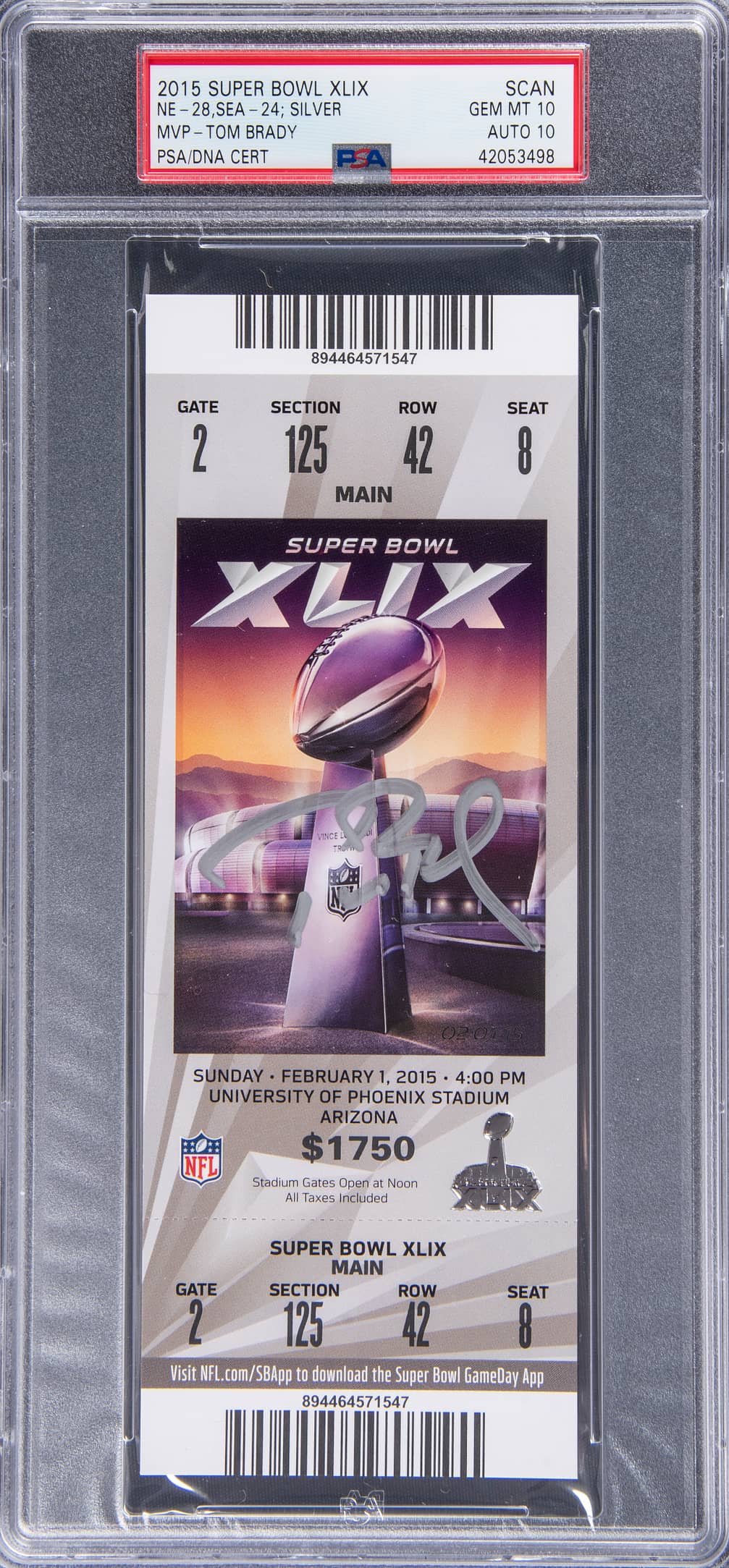
A market full of PSA 10s has to find a new way to separate one copy from the next, and modern tickets are doing it the same way cards did, through the variation. The clearest, and the one we can measure, is the signature. A signed modern ticket sells for a $762 median against $150 unsigned, a 5x premium, far wider than the 2x signed premium across all eras, precisely because the base modern ticket is so cheap and so common that the autograph is most of the value. The top modern sale we track is a signed Shohei Ohtani debut and first-postseason-homer pair at $125,660, both gem-mint with none graded higher.
| Sale | Year | Grade | Price |
|---|---|---|---|
| Shohei Ohtani signed debut + postseason pair, none higher | Year2018-24 | GradePSA 10 | Price$125,660 |
| Tom Brady signed Super Bowl XLIX Silver Variation | Year2015 | GradePSA 10 | Price$21,600 |
| Shohei Ohtani signed first MLB home run, Pop 1 | Year2018 | GradePSA 10 | Price$21,960 |
| Tom Brady signed Super Bowl LIII full scan ticket | Year2019 | GradePSA 10 | Price$7,380 |
| Connor McDavid NHL debut full ticket, one of two | Year2015 | GradePSA 10 | Price$6,405 |
The vintage rulebook still holds for vintage tickets: a battered low grade can be the most valuable thing in the room because no clean one survived. But that book was written by scarcity, and modern tickets are not scarce in that way. Digital entry made the full ticket the default, gem-mint made the top grade common, and the market is responding the way it did with cards, by pricing the gem tier and the variation instead of mere survival. The modern ticket is a condition-and-variation asset, and that is a different market from the one most ticket lore was written about.
Explore the data behind this report
Search every graded ticket sale, browse PSA population data, and track sold prices on Collectors Tools.