 Collectors Tools
How our ticket collecting database connects population, scans and sales
Does the ticket exist, which copies are out there, and what do they sell for. A ticket collecting database has to answer all three, and each answer lives in a different database. One 1947 Jackie Robinson stub shows how they connect.
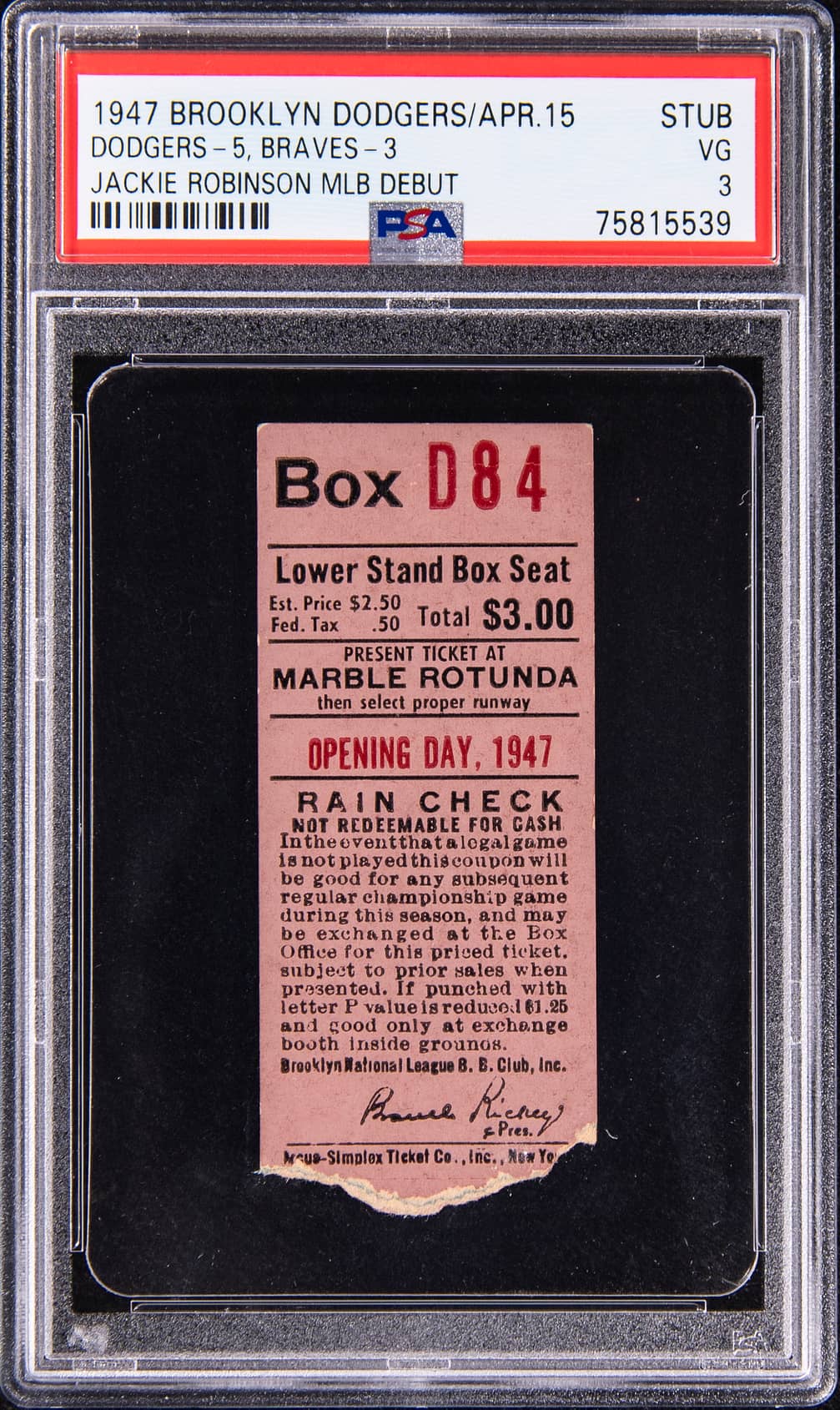
In December 2025 a torn stub from Jackie Robinson's MLB debut, graded PSA 3, sold at Goldin for $366,000. Whether that price makes sense depends on three separate facts: only 14 copies of the stub have ever been graded and none higher than PSA 4; that exact cert is the only PSA 3 among them; and the same slab had sold for $300,000 two years earlier. No single list holds all three facts. They come from the three parts of our ticket collecting database, and this post walks through what each one is for, what each holds, and how they join. Every figure is a live read of our own data as of 18 July 2026; population counts come from the July 2026 PSA census.
The three parts of the ticket collecting database
| Database | One row is | Size | It answers |
|---|---|---|---|
| Population report | One row isOne ticket in one form (the full, stub or pass of an event) | Size87,132 entries | It answersDoes it exist, and how rare is it at each grade? |
| Ticket scans | One row isOne graded copy, keyed by its PSA cert number | Size81,353 certs | It answersWhich exact copies are out there? |
| Sales record | One row isOne auction result | Size17,534 graded sales | It answersWhat has it actually sold for? |
The population database counts what exists
The population report is the catalogue layer: 87,132 entries across 37,708 PSA set headings, folded into 68,210 distinct moments so that the full ticket, the stub and the pass of the same event read as one moment rather than three unrelated listings (why that folding matters is its own article). The July 2026 census puts real counts behind every entry: 279,911 graded tickets, of which 21,484 (7.7%) are GEM MT 10. For the Robinson debut stub it reads 14 graded copies ever, six of them Authentic, finest known PSA 4. That is the number to check before bidding, not the rarity claim in a listing title; how to search the report is covered here.
The scan database identifies the exact copy
Population counts are anonymous: 14 graded stubs, but which 14? The ticket scan database is the copy-level layer, 81,353 individual certs, each keyed by the number printed on its PSA label, with the grade, year, autograph status and, for 63,878 of them (78.5%), the slab image. Search any cert number and the exact copy comes up. Six of the 14 Robinson debut stubs are in the reference, including cert 75815539, the PSA 3 from the sale above. This is the layer that verifies a slab: if the cert number on a listing does not match the grade and event on file, walk away.
The sales database prices the moment
The sales record holds 17,534 graded-ticket sales worth $31.3 million, December 2003 to July 2026, compiled from Heritage, Goldin and Fanatics Collect, alongside 298 live listings as of 18 July 2026. For the Robinson debut stub it holds five results:
| Date | Grade | Price | House |
|---|---|---|---|
| Feb 2022 | GradePSA 2 | Price$480,000 | HouseHeritage |
| Dec 2025 | GradePSA 3 | Price$366,000 | HouseGoldin |
| Aug 2024 | GradePSA 1.5 | Price$324,000 | HouseHeritage |
| Aug 2023 | GradePSA 3 | Price$300,000 | HouseHeritage |
| Feb 2021 | GradeAuthentic | Price$40,800 | HouseHeritage |
The links turn three lists into one ticket collecting database
Two joins hold the system together. Sales attach to scans by the cert number: 14,330 of our graded sales carry one, which resolves 10,214 exact copies to a sale history. Scans attach to the population report by set heading and moment: 96% of the scan database is linked to its population group. Each join answers something no single database can. Cert matching is how we know the 2023 and 2025 Robinson sales were the same slab, up 22% in 28 months, not two different copies. Population context is how a PSA 2 selling for $480,000 stops looking absurd: the census says nothing above PSA 4 exists, so PSA 2 is a high grade for this ticket, the pattern behind why grades mean nothing without the population. And when a copy has never sold, the joins supply the comparable: same moment, same grade, nearest sale.
Which database for which situation
| You want to | Start in | Then |
|---|---|---|
| Check how rare a ticket really is before bidding | Start inPopulation report | ThenRead the graded count for each form and grade; a listing's rarity claim is not the census |
| Verify a slab you have been offered | Start inTicket scans | ThenSearch the cert number; the grade, event and slab image on file should match what is in front of you |
| Price a ticket you own | Start inSales record | ThenFind same-moment sales at your grade; if your grade never sold, use the nearest grade as the comp |
| See what is on the market right now | Start inLive auctions | Then298 graded listings live across the houses we aggregate, as of 18 July 2026 |
Try the population database
Type a name and results appear instantly. Groups with a View examples button open the real graded slabs at each grade, in place.
One moment, one cert, one price. The population report says 14 Robinson debut stubs exist. The scan reference names six of them by cert. The sales record prices five results for the moment, including the same slab twice. Read separately, each is a list; joined, they answer the questions collectors actually ask. For the market-wide view of what exists, see the full graded-ticket census; for what prices respond to across the whole record, what drives graded ticket prices.
Explore the data behind this report
Search every graded ticket sale, browse PSA population data, and track sold prices on Collectors Tools.