 Collectors Tools
How many PSA graded tickets exist? We counted all 279,911
In July 2026 we counted the entire PSA graded-ticket population on one date: 279,911 graded copies across 69,676 items. Here is that market mapped by era, grade, rarity and price, and the baseline every future count is measured against.
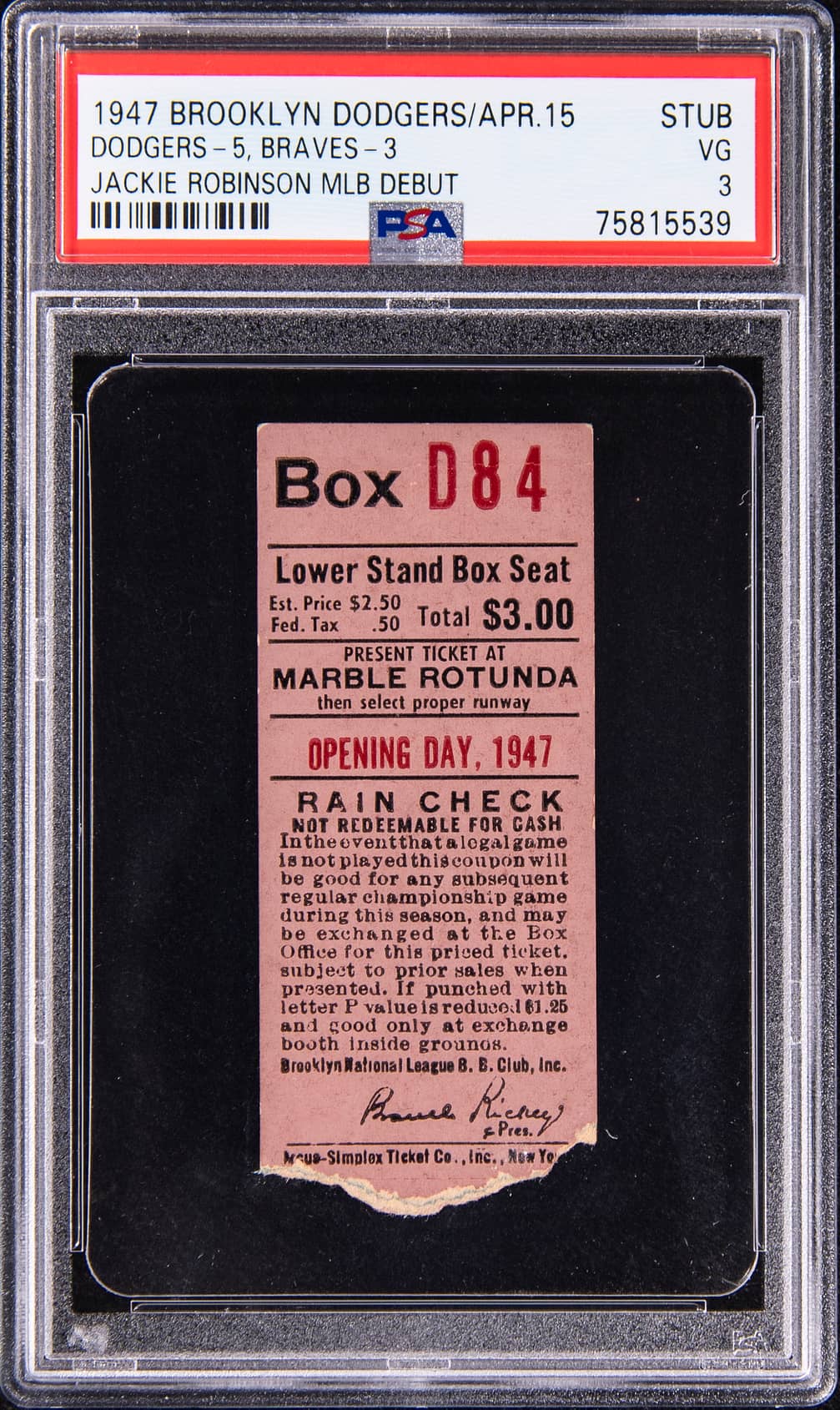
The hobby never had a straight answer to how many PSA graded tickets exist, because no one had counted them all at once. We did. In the July 2026 census (captured 8 to 11 July 2026) we read PSA's population report for every ticket set and totalled it: 279,911 graded tickets, across 69,676 distinct items in 37,053 headings. A census is a point-in-time count, not a live feed, so every number here is stamped to that date and will keep climbing as more tickets are graded. What makes it useful is the date: count the same population again in six months and you get a rate of change, not just a total.
This is one of three databases behind the number. The population census counts what PSA has graded. Our sales database tracks what those tickets actually sell for: 17,490 graded ticket sales worth $31.3M, from December 2003 to 12 July 2026. Our scan reference catalogues 81,265 individual graded examples with images and cert detail. Every sale and every scan is matched to the exact PSA item it belongs to using PSA's own set and item identifiers, so a ticket's population, its images, and its sale history line up on a single record. That is what lets this piece move from a count to a price without guessing.
The market is bigger, and older, than it looks
Sort all 279,911 tickets by the decade of the event on the ticket and the count climbs toward the present, as you would expect from a market where most grading is recent. The 2010s lead with 40,643 graded. The part people underestimate is the vintage core: the 1960s alone hold 31,375, more than the 2020s and nearly level with the 1990s and 2000s, carried by championship games and heavyweight title fights that fans knew to keep.
The two '20s bars are a century apart: the 1920s (3,528) and the 2020s (14,671), which is only four years in and already four times larger. We break the money version of this split in graded ticket sales by decade; this is the same market counted by population instead of price.
Most graded tickets are not mint
Break the census by grade and it looks nothing like a trading-card population. A ticket was made to be torn at the gate, folded into a pocket and thrown away, so the grade curve is the fingerprint of an object that was never meant to survive. Only 7.7% of graded tickets reach GEM MT 10, and 70.2% sit below PSA 8. High grade (PSA 8 to 10) is under a third of everything graded.
Go grade by grade and two features stand out. The single most common numbered grade is NM-MT 8 (34,968), the practical ceiling for a ticket that made it home flat. And the largest tier of all is not a number: 42,848 tickets grade Authentic, trimmed, taped, or too worn to earn a numeric grade at all. That long low-grade tail is unique to tickets. Cards were graded straight from wax packs; tickets were kept in drawers and albums and graded decades later.
A few tickets carry an outsized share of the population
Population is not spread evenly. Most of the 69,676 items exist in tiny numbers, a handful of survivors each, while a short list of moments people knew to save runs into the hundreds or thousands. The ten largest single-item populations below are almost all full tickets (not stubs), because a full unripped ticket only survives when the holder never went in, or kept it as a souvenir.
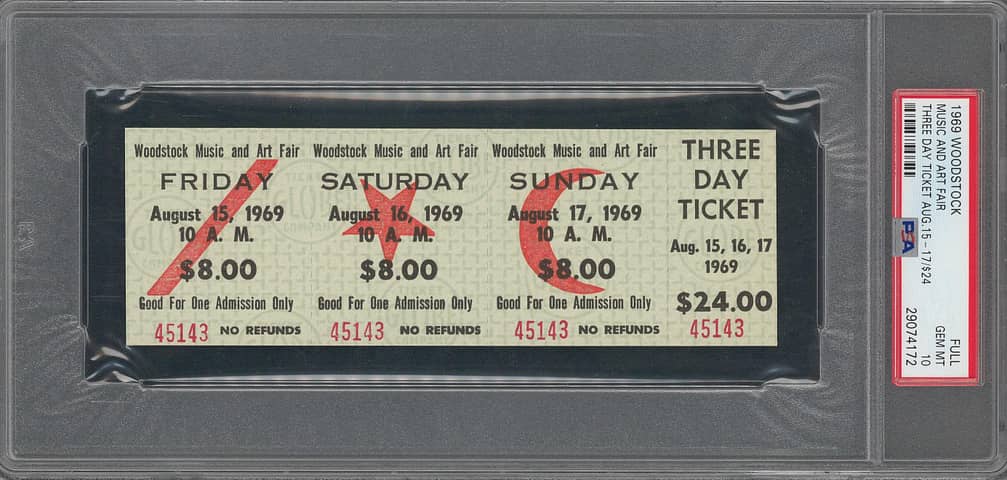
| Ticket | Year | Form | Graded | GEM 10 |
|---|---|---|---|---|
| Woodstock, $24 three-day | Year1969 | FormFull | Graded2,063 | GEM 10646 |
| Cal Ripken Jr. Hit #3,000 | Year2000 | FormFull | Graded859 | GEM 10704 |
| Leonard vs. Duran | Year1980 | FormFull | Graded828 | GEM 10116 |
| Shohei Ohtani MLB HR #1 | Year2018 | FormFull | Graded618 | GEM 10313 |
| Ohtani 1st 50/50 in MLB | Year2024 | FormFull | Graded613 | GEM 10437 |
| Woodstock, Gold | Year1969 | FormFull | Graded610 | GEM 10199 |
| Patterson vs. Liston KO | Year1962 | FormFull | Graded601 | GEM 1043 |
| Woodstock, $18 three-day | Year1969 | FormFull | Graded593 | GEM 1098 |
| Jeter Hit #3,000 | Year2011 | FormFull | Graded554 | GEM 1039 |
| Kobe 60 in Final Game | Year2016 | FormFull | Graded550 | GEM 1046 |
The GEM 10 column tells its own story. Cal Ripken's 2000 3,000th-hit ticket has 704 GEM 10s, the deepest pool of perfect tickets anywhere, more than its next 145 examples combined. Ohtani's two entries (313 and 437 GEM 10s) show the same modern pattern: tickets printed on clean stock, bought to keep, submitted straight to grading. Compare that to Patterson vs. Liston (1962): 601 graded, only 43 perfect. Same census, opposite eras.
What the population is worth
Counting tickets is only half the point; the other half is what they trade for. Across the 17,490 graded ticket sales we track, the median sale is $312 and the average is $1,790. Those two numbers are far apart for a reason: a small number of six-figure results pull the average up while most tickets change hands cheaply.
| Ticket | Grade | Sold | House | Date |
|---|---|---|---|---|
| 1947 Jackie Robinson MLB debut stub | GradePSA 2 | Sold$480,000 | HouseHeritage | DateFeb 2022 |
| 1984 Michael Jordan NBA debut full ticket | GradeAuthentic | Sold$468,000 | HouseHeritage | DateFeb 2022 |
| 1947 Jackie Robinson MLB debut stub | GradePSA 3 | Sold$366,000 | HouseGoldin | DateDec 2025 |
| 1984 Michael Jordan debut stub | GradePSA 8 | Sold$341,600 | HouseHeritage | DateDec 2025 |
| 1939 Lou Gehrig 'Luckiest Man' stub | GradePSA 4 | Sold$280,600 | HouseHeritage | DateMar 2026 |
Interest is rising against a fixed supply. Graded ticket sales we track went from 653 in 2021 to 3,306 in 2022, and have held above 2,700 a year since (3,210 in 2025, 1,939 so far in 2026). The $468,000 Michael Jordan NBA debut full ticket, the only known example, is the piece that pulled tickets into the mainstream; we break it down in the Michael Jordan first-game ticket.
This is a baseline, not a snapshot
One census is a total. Two, six months apart, is a trend: which decades are being graded fastest, whether the GEM 10 share is climbing, which single tickets are gaining population. The chart below has exactly one point today, 279,911, captured on 8 July 2026. Every item also carries its own dated per-grade count, so the same line can be drawn for one ticket or for the whole market. The next capture draws the slope.
Look up any ticket's real population
Type a name and results appear instantly. Groups with a View examples button open the real graded slabs at each grade, in place.
279,911 is the number the hobby never had. On its own it is just a total; the value is everything you can now measure against it: how rare your ticket really is, where its grade sits in the whole market, what its population is worth, and from the next census on, how fast that population is moving. Start with the population report, search a specific cert or player in the ticket scans, or learn to read a single ticket's count in how to search the PSA ticket pop report.
Explore the data behind this report
Search every graded ticket sale, browse PSA population data, and track sold prices on Collectors Tools.