 Collectors Tools
Woodstock ticket prices break the rule because the pristine 1969 ticket is the common one
We pulled every graded 1969 Woodstock full-ticket sale in our database, 468 of them, against PSA's population of 4,705. The result is the rarest thing in the hobby: a 57-year-old icon where the pristine ticket is the common one, the worn survivor is the scarce one, and the market pays for neither.
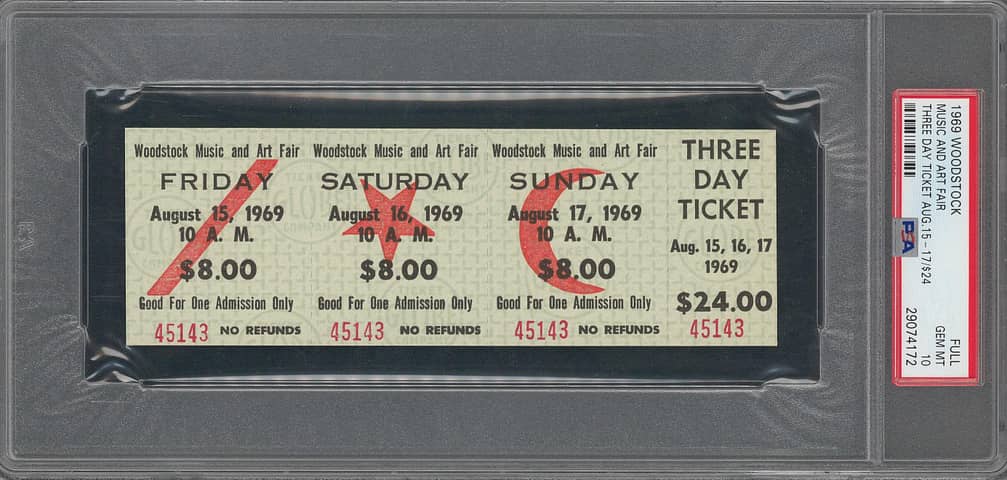
Woodstock ticket prices break the usual rule of the hobby: the pristine ticket is the common one. PSA has graded 4,705 of these 1969 full tickets, and 87% sit at PSA 8 or higher, because the gates were never staffed and a cache of unissued tickets later surfaced intact. The record on our books is a modest $1,920. This is the 1969 Woodstock ticket market, with exact figures.
Every price below comes from 468 graded Woodstock full-ticket sales we track across eBay, Heritage, Goldin and Fanatics Collect, April 2015 to July 2026. Each one is tied to a PSA certification number, so the grade is read from PSA rather than parsed out of a lot title. The population figures are PSA's own census for 1969 Woodstock full tickets, read on July 8, 2026. Prices are realised hammer-plus-premium results, not asks. Multi-ticket lots are excluded throughout, because a pair sold together is not a single-ticket price. You can open any slab in our ticket scan database or read the live population on the Woodstock full-ticket population report.
Why a 57-year-old ticket is common in gem mint
Woodstock sold roughly 100,000 advance tickets by mail, but the on-site ticket booths were never towed into position in time. The crew hired to move two dozen booths managed to place only two or three before the crowd, more than 400,000 people, simply walked in. The organisers declared it free: an estimated 300,000 attendees were never charged, and the tickets printed for the gates were never issued or collected.
The reason so many survive in flawless condition is not 57 years of careful collecting. It traces to a single cache: years later a buyer paid $14,000 for a group of safes that a rental firm, the Cross Safe Company, had leased to Woodstock Ventures and never reopened. Inside were roughly 150,000 unused tickets. Tens of thousands were sold off into the market and still surface at auction today. That find, not fan nostalgia, is why pristine Woodstock tickets are so common.
That history is written directly into the population report. Of the 4,705 graded full tickets, 1,747 are PSA 9 and 1,222 are PSA 10, so mint and gem mint alone are 63% of everything PSA has certified. Genuinely circulated examples, the ones graded Authentic through PSA 4 with the wear of a pocket or a gate, total just 180 tickets, 3.8% of the population. For most vintage paper the pyramid runs the other way. Here it is inverted, and by a factor of 23.
The condition cliff: only a PSA 10 commands a premium
When supply is this deep, grade is the whole price story, and it is a cliff with exactly one step in it. A PSA 10 carries a $367 median across 188 sales. Drop a single point to PSA 9 and the median falls to $169, a 2.2x gap. And then it stops falling. PSA 8 sits at $160, and everything at PSA 7 and below, 29 sales spanning Authentic to PSA 7, has a median of $145. With 1,747 mint examples in circulation, the market pays up for the flawless one and treats the rest as interchangeable.
| Grade | Sales | Median | Range |
|---|---|---|---|
| PSA 10 | Sales188 | Median$367 | Range$115 - $1,920 |
| PSA 9 | Sales174 | Median$169 | Range$71 - $671 |
| PSA 8 | Sales77 | Median$160 | Range$73 - $799 |
| PSA 7 and below | Sales29 | Median$145 | Range$44 - $519 |
The headline sales are all the same item: a Three-Day full ticket in PSA 10. The record $1,920 example sold at Goldin in May 2020, followed by a string of gem-mint Three-Days at $1,440 in September 2022, $1,320 twice, and $1,220 in March 2025. There is no famous-moment premium here, no single trophy ticket. The most valuable Woodstock ticket is simply the most recognisable one in the highest grade.
Do used tickets beat mint ones?
This is the question the inverted pyramid begs. If a worn, genuinely-circulated Woodstock ticket is 23 times rarer than a high-grade one (180 versus 4,079 at PSA 8-10), should it not command more? With 468 sales the answer is now clear, and it is no. The scarcity is real and the market does not pay for it.
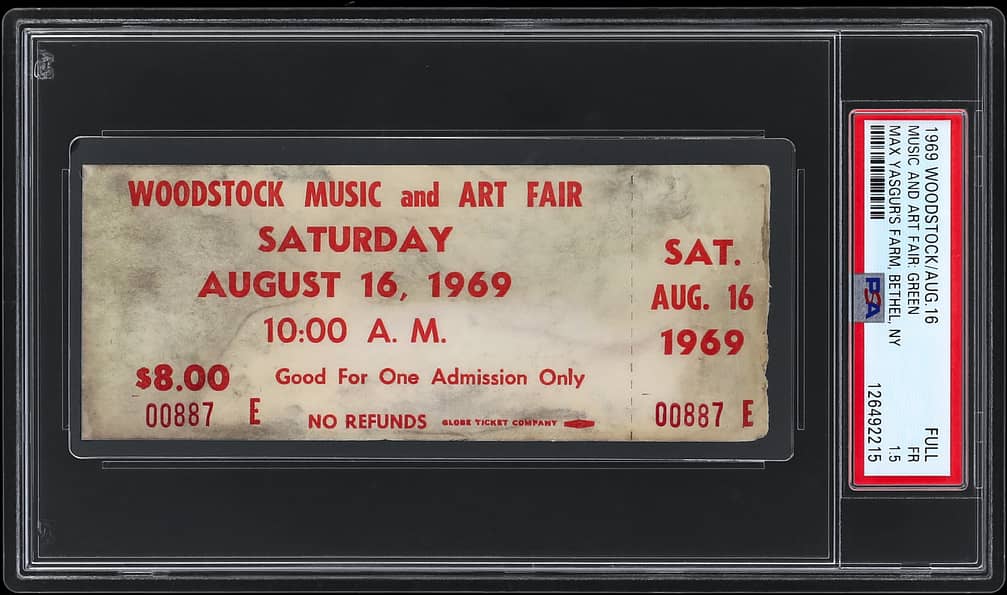
The clearest single counter-example is still there: a PSA 1.5 Fair, a green Aug 16 ticket with real wear, sold for $396.50 in March 2026, more than double the $169 PSA 9 median. But it is one sale. Look at the tier instead of the anecdote and the premium disappears: PSA 4 has a median of $150 across five sales, below the PSA 9 median, and the whole Authentic-to-PSA-7 band medians $145. The starkest figure of all is an absence. PSA has certified 93 Authentic Woodstock full tickets, the most obviously circulated grade in the set, and not one of them has a recorded sale in our archive.
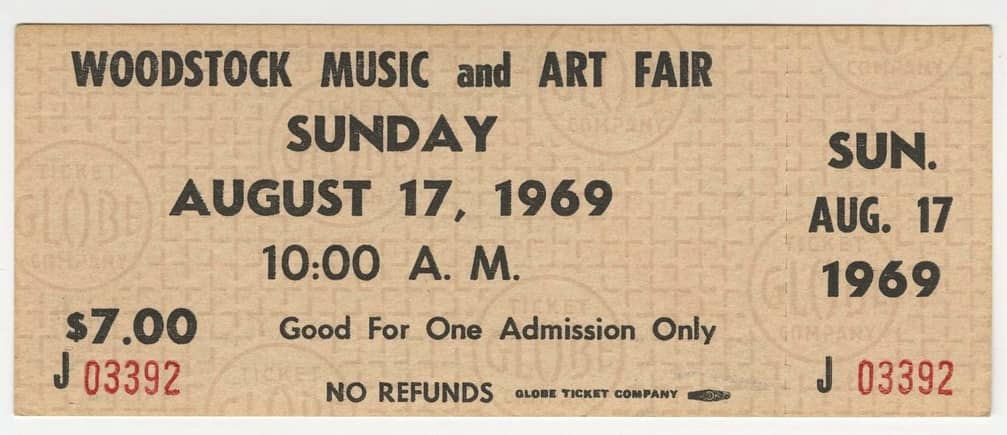
Two sales that used to look like evidence for the worn ticket turn out, on inspection, to be the opposite. A lot of two unused originals made $720, which is $360 each, almost exactly the PSA 10 median. A Heritage lot of ten unused Three-Days in PSA 9 made $990, which is $99 a ticket, well under the PSA 9 median. Lot prices flatter the individual ticket every time, which is why every figure in this piece counts single tickets only. The one genuinely unusual result is the raw unused Sunday ticket at $1,200, and even that is an ungraded ticket bought as an object rather than a grade.
Every Woodstock variation PSA grades
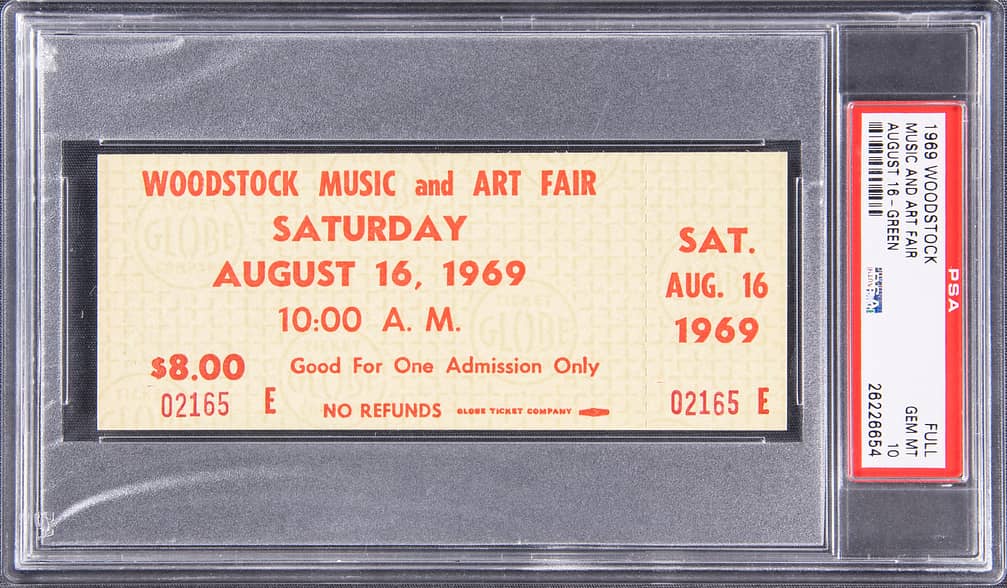
PSA recognises 15 distinct full-ticket variations, and they are not equally common. The festival ran three days with separate tickets, in three colours (beige, gold, green) marking different gates, plus the famous Three-Day ticket sold at two face values. One variation dominates: the $24 Three-Day ticket alone accounts for 2,063 of the 4,705 graded, 44% of the entire population. It is the ticket everyone pictures.
| Variation | Graded (PSA) | Share |
|---|---|---|
| Three-Day, $24 face | Graded (PSA)2,063 | Share44% |
| Aug 16 (Sat), Gold | Graded (PSA)610 | Share13% |
| Three-Day, $18 face (advance) | Graded (PSA)593 | Share13% |
| Aug 16 (Sat), Green | Graded (PSA)298 | Share6% |
| Aug 16 (Sat), Beige | Graded (PSA)197 | Share4% |
| Three-Day, 8/15-8/17 | Graded (PSA)140 | Share3% |
| Aug 17 (Sun), Green | Graded (PSA)127 | Share3% |
| Aug 15 (Fri), Beige | Graded (PSA)117 | Share2% |
| August 17 (plain) | Graded (PSA)107 | Share2% |
| Aug 17 (Sun), Gold | Graded (PSA)95 | Share2% |
| August 15 (plain) | Graded (PSA)79 | Share2% |
| Aug 15 (Fri), Green | Graded (PSA)77 | Share2% |
| Aug 15 (Fri), Gold | Graded (PSA)72 | Share2% |
| Aug 17 (Sun), Beige | Graded (PSA)66 | Share1% |
| August 16 (plain) | Graded (PSA)64 | Share1% |
Scarcity and price do not line up the way you would expect, and that is the most interesting feature of this market. The single-day tickets are far rarer than the Three-Day (an Aug 17 beige is graded just 66 times against 2,063), yet the Three-Day still sets every price record. Recognition beats rarity here: demand concentrates on the one ticket that reads as *the* Woodstock ticket, so it stays the most liquid and most valuable despite being the most common. The scarcer single-days and colour variants trade at a discount, not a premium, until a collector is specifically chasing the set.
| Variation group | Graded | Sales | Median |
|---|---|---|---|
| Three-Day, $18 face | Graded593 | Sales55 | Median$240 |
| Three-Day, $24 face | Graded2,063 | Sales333 | Median$234 |
| Single-day, Beige | Graded380 | Sales25 | Median$200 |
| Single-day, Gold | Graded777 | Sales39 | Median$180 |
| Single-day, Green | Graded502 | Sales16 | Median$162 |
This is a correction to an earlier reading of ours. On the 254 sales we held in June 2026 the green single-days looked like they led the colour variants at a median near $342. They do not. On 468 sales green is the cheapest of the three colours at $162, behind beige at $200 and gold at $180, and all three sit below both Three-Day printings. The earlier figure was a thin sample doing what thin samples do. The two Three-Day face values, the $18 advance mail-order ticket and the $24 ticket, grade similarly high and trade within $6 of each other; the $24 is both more common and more sought, the default trophy of the set.
A flat, liquid market over a decade
Unlike the explosive sports-ticket markets, Woodstock has been remarkably stable. The annual median has held in a $129 to $351 band for twelve years with no supply-shock spike, because the supply was always there: thousands of pristine tickets, drip-fed to auction. The 2021 to 2022 bump is the same pandemic-era lift the whole collectibles market took, and it gave most of itself back. It is one of the most liquid affordable relics in the hobby, a genuine piece of 1969 you can own in gem mint for a few hundred dollars.
Volume tells the same story from a different angle. 2019 was the busiest year on record with 78 sales, the festival's fiftieth anniversary, and the market has settled since into a steady 60 to 70 a year. Across the whole archive 408 distinct certificates account for the 468 sales, so Woodstock tickets do change hands twice, but most of what trades is a ticket the market has not seen before. We hold 1,056 of the 4,705 graded examples as individual scanned certs, which is where every figure above is anchored.
Top recorded Woodstock ticket sales
| Price | Date | Cert | Source | Grade |
|---|---|---|---|---|
| $1,920 | DateMay 2020 | Cert29074172 | SourceGoldin | GradePSA 10 |
| $1,440 | DateSep 2022 | Cert42520272 | SourceHeritage | GradePSA 10 |
| $1,320 | DateJan 2021 | Cert25033441 | SourceGoldin | GradePSA 10 |
| $1,320 | DateJan 2024 | Cert42520202 | SourceHeritage | GradePSA 10 |
| $1,220 | DateMar 2025 | Cert42520281 | SourceHeritage | GradePSA 10 |
| $1,200 | DateJul 2024 | Cert44993493 | SourceeBay | GradePSA 10 |
| $1,110 | DateOct 2024 | Cert42520247 | SourceHeritage | GradePSA 10 |
| $1,050 | DateApr 2021 | Cert50259142 | SourceHeritage | GradePSA 10 |
| $976 | DateMay 2026 | Cert126492187 | SourceGoldin | GradePSA 10 |
| $950 | DateJul 2024 | Cert44894199 | SourceeBay | GradePSA 10 |
Two entries in that list did not exist when we first published this piece, and both came from eBay rather than the auction houses. Adding eBay to the archive nearly doubled the Woodstock record, from 254 sales to 468, and it moved every median in the piece. It also changed one headline for a day: an eBay result of $2,100 briefly stood as the record, until the original listing turned out to be two tickets sold together. It is withdrawn, and the $1,920 Goldin sale from May 2020 still stands as the highest price ever paid for a single graded Woodstock ticket.
One footnote on the set. PSA also grades a separate Woodstock stub report, and it is almost empty by comparison: 66 graded examples against 4,705 full tickets. Nobody tore a ticket that was never collected, which is the same fact the population report has been telling us all along, seen from the other end. And a PSA 7 Three-Day at $518.50 in August 2025 remains the best result any Woodstock full ticket below PSA 8 has managed.
The arc: a cultural icon that is paradoxically common in pristine grade because its gates were never staffed and a cache of 150,000 unissued tickets later surfaced from a safe; a hard condition cliff with exactly one step in it, where only the PSA 10 breaks away and everything from Authentic to PSA 9 trades in a $145 to $169 band; a used-ticket scarcity the market flatly refuses to price, where a worn survivor is 23x rarer than a high grade and 93 Authentic examples have never recorded a sale; and recognition beating rarity, with the common Three-Day outselling every scarcer variation. For Woodstock, the ticket prices the memory, not the scars.
Explore the data behind this report
Search every graded ticket sale, browse PSA population data, and track sold prices on Collectors Tools.