 Collectors Tools
Thirty questions about ticket collecting, answered from the data
The questions collectors ask most, answered in two sentences each from the largest set of graded ticket records in the hobby.
Nothing below is an opinion. The price answers come from 17,610 graded ticket sales we track across Heritage, Goldin and Fanatics Collect, worth $31,234,295 between September 2004 and 2 August 2026. The rarity answers come from the first complete census of PSA's ticket population, 279,911 graded tickets across 69,676 item varieties, read on 8 July 2026.
Ticket collecting FAQ, money and investment
The most useful number in this section is not an average price, it is what happened to people who bought and later sold the same ticket. We can follow 768 certificates that sold more than once, which turns opinion about the market into a measurement. Grouped by the year the buyer bought, the median change on the next sale looks like this.
| Year bought | Resales tracked | Median change on resale |
|---|---|---|
| 2019 | Resales tracked14 | Median change on resale+40% |
| 2020 | Resales tracked30 | Median change on resale+82% |
| 2021 | Resales tracked59 | Median change on resale-18% |
| 2022 | Resales tracked244 | Median change on resale-38% |
| 2023 | Resales tracked126 | Median change on resale-17% |
| 2024 | Resales tracked131 | Median change on resale-5% |
| 2025 | Resales tracked65 | Median change on resale+12% |
The correction bottomed in 2022, not 2021, and it ran longer than most people remember: a ticket bought in 2023 still resold 17% below what its owner paid. The first positive median since the peak is 2025, at +12%.
- Do graded tickets hold their value, or is this a bubble?
- It was a correction, not a bubble, and it is measurable: across 768 tickets that have sold more than once, buyers in 2022 are down 38% at the median while 2025 buyers are up 12%. The losses concentrated in one window rather than spreading across the market, and the collectors who arrived during the correction are the base that stayed.
- How liquid is a graded ticket? How long until I can sell it?
- It depends entirely on the moment, not the grade. Only 5,537 groups in the population database have ever recorded a tracked sale, so a professional debut has a waiting audience and moves quickly, while a lesser milestone can sit until the one collector who wants it appears.
- Is a big moment in low grade better than a small moment in high grade?
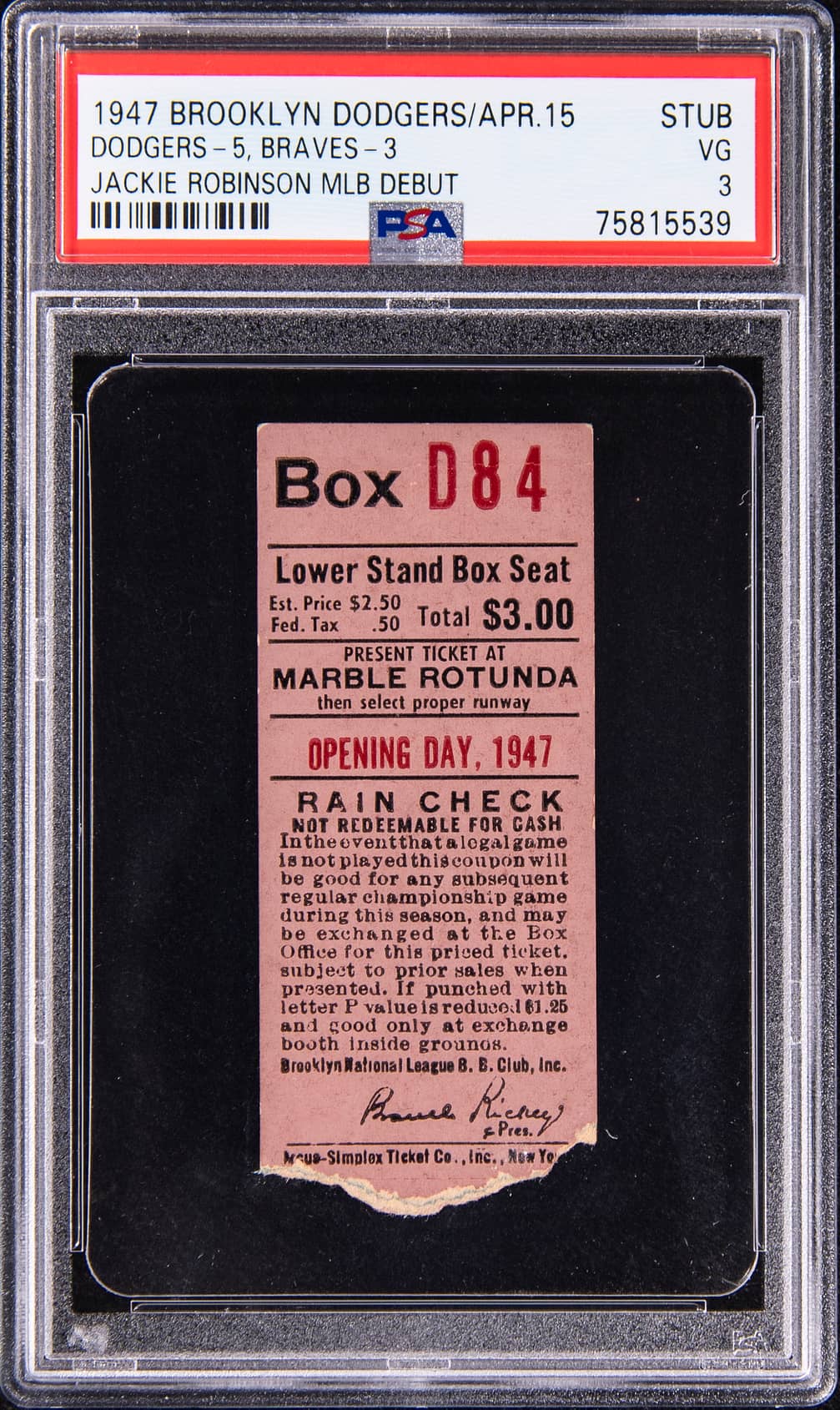
- The big moment, and the two highest sales on record prove it: Jackie Robinson's 1947 debut stub at $480,000 in a PSA 2, and Michael Jordan's debut full ticket at $468,000 in PSA Authentic. That is shifting as card money arrives and bids up the top grades, but with 41,134 items sitting at population 1 the moment still sets the price.
- Do signed tickets sell for more than unsigned ones?
- Yes, by roughly three times at the same grade: signed PSA 9 tickets have a median of $510 against $168 for unsigned, across 1,473 sales at that grade. Every ticket autograph is also signed in person on the ticket itself, which is not true of the sticker autographs used on many cards.
- Does the auction house change the price I get?
- More than it should, because no house has claimed this category yet. Heritage and Goldin carry the top end (medians of $488 and $330, and both record sales), while Fanatics Collect's median is $113, so a good ticket can go unnoticed in the wrong sale.
- How much money do I need to start collecting tickets?
- Less than most people assume: 62.8% of every sale we track closed under $500, and 20.4% under $100. Genuinely significant moments still sit unrecognised inside ordinary collections, which stopped being true of the best-known trading cards years ago.
- Are debut tickets always the best thing to buy?
- They carry a real and measurable premium: debut lots have a median of $516 against $288 for everything else, across 17,610 sales. Collectors arriving from cards want the earliest possible item connected to a player, and a debut ticket is the only object that dates the moment itself.
- Which sport holds its value best?
- Baseball and basketball, effectively tied at the top. The 30 highest sales we track split 11 lots worth $2.51M to baseball and 11 worth $2.18M to basketball, with football third at $779,000 and single entries for hockey at $158,600 and golf at $99,000.
- Do ticket prices spike on anniversaries, milestones and deaths?
- Anniversaries move almost nothing, milestones move a lot, and milestones are the only one you can act on in advance: if a player sits on 998 goals, the ticket for the next game is buyable before the record happens. Deaths lift prices too, hardest on signed items, because the supply of genuine autographs closes permanently on that day.
- Is it cheaper to buy a graded ticket or buy raw and grade it yourself?
- Buying raw and grading it yourself is almost always cheaper. Grading also improves the item it grades, because a folded or creased ticket presents far better held flat in a slab, which is rarely true of a card.
Grading, rarity and building a collection
Tickets were used. They were folded to fit a pocket, torn at the gate, and stapled into programmes, and the grade curve shows it: 165,692 graded tickets sit at PSA 6.5 or below, against 21,484 that reached a PSA 10.
- Should I grade my ticket, and when is it not worth it?
- Grade it when it is worth meaningfully more than the fee, and do it sooner rather than later, because PSA's pricing has risen year on year and now adds charges on high-value and high-grade tickets. The case to skip is a low-value ticket where the fee would swallow most of what the ticket is worth.
- What do graders punish most? Why did my ticket come back low?
- A fold through the middle caps a ticket at roughly a PSA 3 and a staple hole at roughly a 2 or 3, which is why the population is bottom-heavy: 165,692 graded tickets sit at 6.5 or below. Compare your ticket against thousands of graded examples in the scan database to see what PSA punished on the same item.
- My ticket has a pen mark. Can it still grade well?
- Yes, up to a ceiling. A pen mark earns the MK qualifier and is survivable a long way up the scale, and our records hold 34 tickets graded 9 (MK) and not a single 10 (MK), so a marked ticket can reach Mint but never Gem Mint.
- How do I know if my ticket is real?
- Grading is the answer, and it is the reason this hobby scaled at all. Short of buying it outside the stadium on the day of the event, a graded slab is the only thing that reliably turns a piece of printed card into something tradeable.
- Why do some events have thousands graded and others only one?
- Predictability and occasion decide it. Baseball and basketball telegraph their debuts so spectators keep the ticket, football debuts often land in unglamorous mid-season or qualifying games nobody thought to save, and Messi's 2003 Barcelona debut is common for two reasons at once: every attendee was given a ticket, and the game was the stadium's inauguration.
- How do I find out how rare my ticket actually is?
- Search the event in the population database, which carries PSA's full per-grade census, and match the exact variety wording from your label rather than the game. Rarity is more ordinary here than in cards: 41,134 of the 69,676 items PSA has graded exist as a single example.
- What is the difference between a ticket, a stub, a pass, a proof and a phantom?
- A full ticket is worth the most because a full can always become a stub and never the reverse, and passes sit below both because more of them survived intact. Proofs and phantoms carry little value because they never admitted anyone to the event, and the census counts 16,249 stub headings, 16,201 full, 4,369 pass, 599 proof, 215 badge and 203 phantom.
- Should I collect by player, team, venue or moment?
- Collect what you love or what you believe will hold its value, because there is no structurally correct answer. Big moments carry the deepest demand while niche ones are where a collection stands out, and even the most common tickets top out in the low hundreds of examples.
- Why do two identical-looking tickets get different grades?
- Centering, corner wear, where the tear falls and where the staple went all decide it, and none of that is readable in an angled listing photograph. This is exactly what a scan database is for, because comparing many graded examples of the same ticket shows what separated a 4 from an 8.
- My certification number is not in the population report. What happened?
- PSA renumbers its headings and item records when it re-catalogues a set, so a certificate can point at a page that no longer resolves. If your ticket is missing from our population report, you can add it on the contribute page and it joins the index.
The wider graded ticket market
A small number of names carry this market. Michael Jordan alone accounts for 15.5% of every dollar we track, and twelve names together account for 51.2%.
Card money reaching tickets is visible in a single player. Messi's ticket median has risen every year since the correction, and 2026 is his strongest year by value since the 2022 peak.
- When did ticket grading start, and why?
- Earlier than most collectors assume, and originally to authenticate the autograph on a ticket rather than to grade the ticket itself. Interest built from around 2000, stepped up in 2012 and rose sharply in 2020, and BGS opening a dedicated ticket department with specialist hires is the clearest sign the category is now permanent.
- What is the oldest graded ticket?
- A private viewing at Somerset House in London in 1827, exhibiting work by Turner and Constable. The catalogue also holds Queen Victoria's 1838 coronation at Westminster Abbey, an 1847 meeting in Brussels listing Marx and Engels among its delegates, and the 1851 Great Exhibition.
- What is the most expensive ticket ever sold?
- Jackie Robinson's 1947 debut stub at $480,000, sold at Heritage in February 2022 and graded PSA 2. Jordan's debut full ticket sold the same night for $468,000 in PSA Authentic, so the two largest sales in the hobby are both low-grade tickets.
- Do ticket prices follow trading card prices?
- Generally yes, with a lag of a few months that narrows as the two markets converge. Messi is the clearest live example, with his ticket median climbing every year from $510 in 2022 to $806 in 2026 as card interest in him peaked.
- What happens to ticket collecting now that tickets are digital?
- Print-at-home tickets are not collected, because anyone can print another copy, and the supply gap is already visible: events from the 2020s account for 14,441 graded tickets against 39,654 for the 2010s, even allowing that the decade is unfinished. The counter is that organisers including FIFA are still issuing printed and souvenir tickets through the 2026 World Cup.
- How many tickets does PSA grade each year?
- PSA graded roughly 43,000 tickets in 2025, about 4% more than the year before. Set against the 279,911 tickets in the full population census, that means close to 15% of every graded ticket in existence was graded in that single year, so the category is still expanding quickly against a small base.
- How many graded tickets are genuinely population 1?
- 41,134, which is 59% of every item variety PSA has graded, and 61,927 varieties have five examples or fewer. That scarcity is the single biggest structural difference between graded tickets and graded cards.
- Do concert and non-sport tickets matter?
- They matter, they simply top out lower: the Beatles' first US concert full ticket made $41,480 in PSA 7 and Elvis Presley's last live performance made $34,800 in PSA 8, against $480,000 at the top of sport. The same logic drives both markets, with first shows and final shows carrying the money.
- Does it matter whether a ticket is graded by PSA, BGS or SGC?
- PSA dominates by a margin nothing else approaches: 16,862 of the graded sales we track are PSA, against 683 BGS and 65 SGC. BGS is building a serious ticket department and is worth watching, while SGC is not yet a meaningful factor in this market.
- How much of the ticket market is a handful of names?
- Twelve names account for 51.2% of every dollar we track. Michael Jordan alone is 15.5% at $4,851,888, ahead of Tom Brady at 7.7% and Jackie Robinson at 5.8%.
The through line across all thirty answers is that this market prices the moment first and the grade second, and that most of it is affordable: 11,053 of the 17,610 sales we track closed under $500, including 511 in the last 90 days.
Explore the data behind this report
Search every graded ticket sale, browse PSA population data, and track sold prices on Collectors Tools.