 Collectors Tools
The 20 most valuable graded tickets, ranked by market cap
Every PSA-censused copy of a ticket, priced at its grade from recorded sales and added up. Michael Jordan's NBA debut leads at $4.27 million on 79 copies; Woodstock makes the list on 3,020 of them.
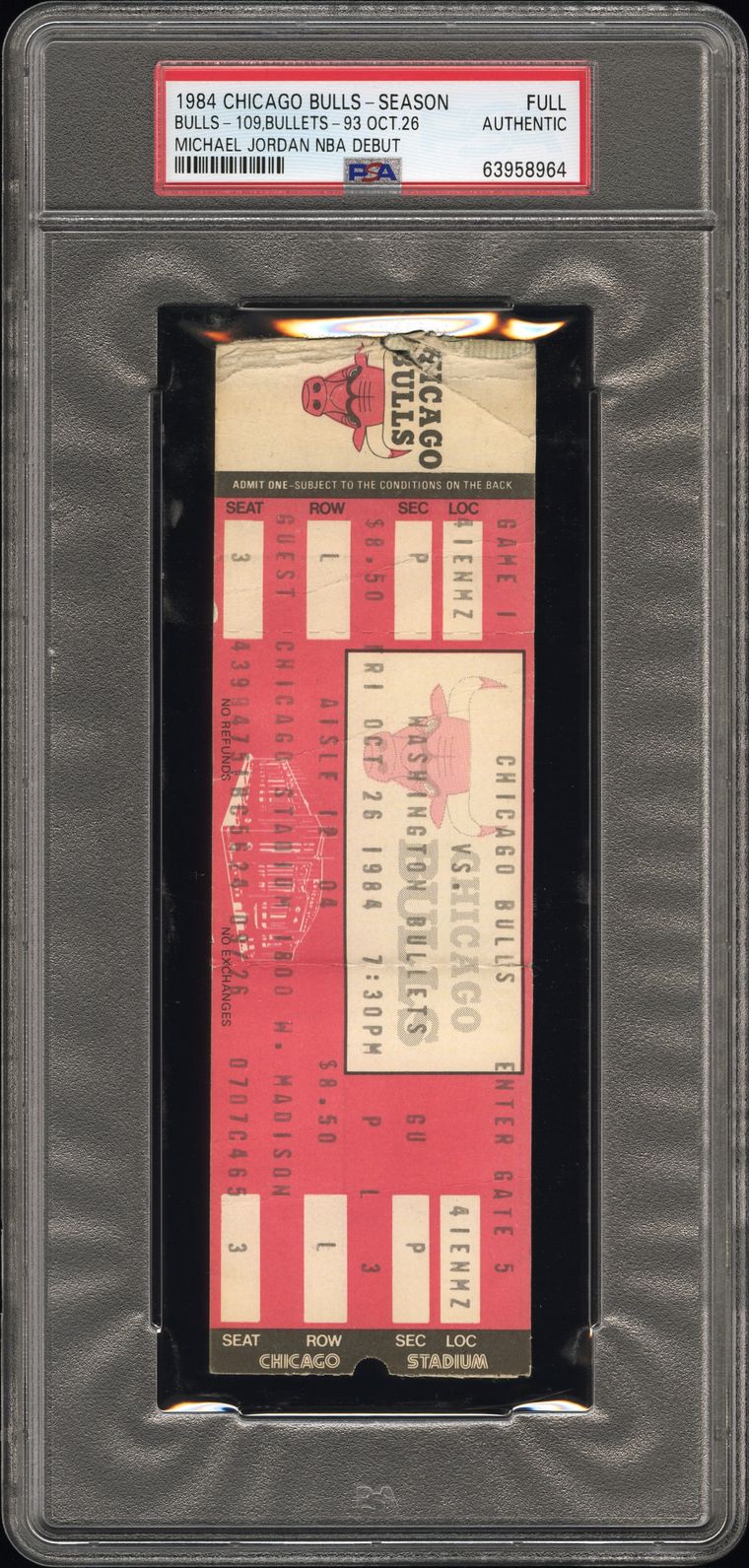
How market cap is calculated, and why it is calculated this way
A ticket's market cap is the value of every graded copy PSA has counted, at today's prices, added together. Take PSA's census population of the ticket grade by grade, multiply each grade's count by a price for that grade, and sum. It is the same idea as a company's market capitalisation: not what you would get selling every copy at once, but what the whole graded population is worth at the prices the market has actually paid. The list below is counted down from 20 to 1. The live version, rebuilt after every day's sales, is at collectorstools.com/rankings.
Pricing a grade. A grade with recorded sales is priced at the median of those sales, not the mean, so one runaway lot cannot reprice a whole population. A grade with no sales is priced on a straight line between the nearest sold grades either side of it: if a PSA 7 sold for $1,000 and a PSA 5 for $500, a PSA 6 is taken at $750. Half grades sit on the same line at their numeric value. Above the highest sold grade, and below the lowest, the price is held flat at the nearest sold grade rather than extended. That choice can understate a top grade that has never sold; it can never invent a premium nobody has paid, which is the error we would rather make in a public ranking.
Forms are priced separately. A stub and a full ticket from the same night are different objects with different prices, so each form (stub, full, pass) gets its own curve from its own sales, and the forms are then added. Michael Jordan's debut is 78 stubs priced off 39 stub sales plus one full ticket priced off its one sale. The two are never mixed.
Which sales count, and which do not. Only sales we can place on an exact PSA cert are used, so the grade is PSA's, read from the cert, never a grade parsed from an auction title. That rule matters more than it sounds: title parsing lifts numbers that are not grades at all, a "1954 World Series Game 1" becoming a grade 1, a "Game 7" becoming a grade 7. Signed copies are excluded from the prices, because an autograph prices the signature, not the ticket: PSA grades the two separately and a PSA 1 stub with a GEM MT 10 autograph is still a PSA 1 ticket. Signed copies still count in the population, since they exist and are graded; they simply do not set the price of an unsigned copy. Multi-ticket lots and lots bundling a ticket with something else are excluded (a Wilt Chamberlain stub sold with a signed programme would otherwise sit in the record books at the pair's price). Withdrawn sales are excluded. Every price is in US dollars as the house reported it.
What qualifies. A ticket enters the list with at least five qualifying sales across two or more grades. One sale pricing 335 copies flat is arithmetic, not a valuation: on the first draft a single $3,050 boarding pass put a Pokémon promotional item at number eight with a seven-figure figure, which is exactly the kind of number this rule exists to keep out. Every entry carries its direct share, the proportion of its population priced at a grade that actually sold; the rest is interpolated, and the per-grade ladder behind each figure is on the rankings page.
Population is PSA's census, not our own holdings. Counts come from PSA's population report as captured on 8 July 2026, the latest complete census, resolved per catalogue row so a re-catalogued ticket sums across every heading PSA lists it under. We never substitute the number of certs we happen to hold for the population. About half the catalogue has not been censused yet, and a ticket with sales but no census is not ranked, because a count we do not hold is not zero. Sales are the 24,669 cert-confirmed graded-ticket sales we have recorded across Heritage, Goldin, Fanatics Collect, Lelands, REA, SCP, Huggins & Scott, Christie's and more, plus eBay, to 16 September 2026. No private sales.
20 to 16, where volume gets a ticket on the list
| # | Ticket | Graded | Sales used | Market cap |
|---|---|---|---|---|
| 20 | Ticket1972 Roberto Clemente 3,000th hit, 57 stubs and 6 full | Graded63 | Sales used18 | Market cap$504,222 |
| 19 | Ticket1986 Super Bowl XX, 122 full and 21 stubs | Graded147 | Sales used17 | Market cap$525,126 |
| 18 | Ticket1996 Kobe Bryant NBA debut, 24 stubs and 2 full | Graded26 | Sales used10 | Market cap$531,432 |
| 17 | Ticket1956 Don Larsen perfect game, 346 stubs, 23 full, 4 proofs | Graded373 | Sales used57 | Market cap$555,023 |
| 16 | Ticket1968 Super Bowl II, 210 stubs, 21 full, 5 proofs, 4 passes | Graded240 | Sales used47 | Market cap$557,980 |
The bottom five show the two ways onto this list. Kobe Bryant's 1996 debut gets there on 26 copies at $20,440 each, one of which, the only full ticket to have sold, went for $75,000 as a PSA 2. Don Larsen's perfect game gets there on 373 copies at $1,488 each. Same neighbourhood of market cap, a fourteen-fold difference in what one copy is worth. Super Bowl XX is the odd one among the four Super Bowls here: it is the only one where full tickets (122) outnumber stubs (21), and the fulls carry $499,706 of its $525,126. Roberto Clemente's 3,000th hit rounds out the twenty on 63 copies, its 6 full tickets alone worth $217,905 against $286,317 for the 57 stubs.
15 to 11, three thousand Woodstocks against twenty-five Mantles
| # | Ticket | Graded | Sales used | Market cap |
|---|---|---|---|---|
| 15 | Ticket2016 Kobe Bryant scores 60 in his final game, 557 full | Graded560 | Sales used60 | Market cap$564,809 |
| 14 | Ticket2001 Tom Brady enters for Drew Bledsoe, 118 stubs and 61 full | Graded179 | Sales used24 | Market cap$568,309 |
| 13 | Ticket1969 Woodstock, 3,001 full and 19 stubs | Graded3,020 | Sales used416 | Market cap$690,742 |
| 12 | Ticket1980 Miracle on Ice, 148 full and 32 stubs | Graded180 | Sales used15 | Market cap$744,872 |
| 11 | Ticket1951 Mickey Mantle MLB debut, 25 stubs | Graded25 | Sales used16 | Market cap$777,450 |
Woodstock is the clearest case of volume. PSA has censused 3,020 copies, 3,001 of them full tickets, and we hold 416 unsigned sales of them, more than any other entry. At a per-copy value of $229 that adds to $690,742, thirteenth on the list. Two places above it, Mickey Mantle's debut reaches $777,450 on 25 stubs, $31,098 a copy, priced off 16 sales that include a $115,200 PSA 1.5. The Miracle on Ice carries the lowest direct share in the top twenty, 52%: its 148 full tickets are priced off only nine full-ticket sales at three grades, so most of that population sits on the interpolated part of the curve. It still makes the list because the fulls it has sold sell high. Kobe Bryant's 60-point farewell is 557 full tickets at about $1,009 each, a modern ticket graded in real time by a crowd that knew what it was watching.
10 to 6, ten stubs worth $800,000
| # | Ticket | Graded | Sales used | Market cap |
|---|---|---|---|---|
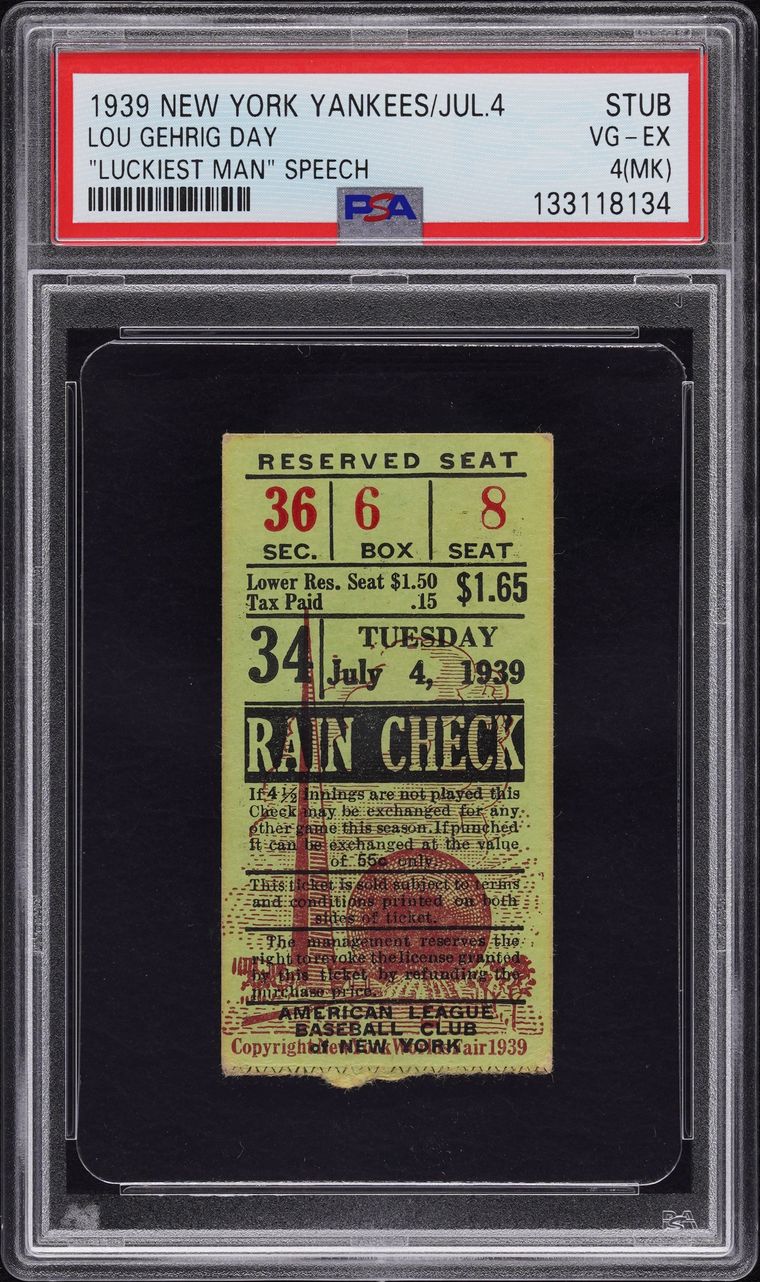
| 10 | Ticket1939 Lou Gehrig Day, the Luckiest Man speech, 10 stubs | Graded10 | Sales used8 | Market cap$800,500 |
| 9 | Ticket2000 Tom Brady NFL debut, 58 stubs and 11 full | Graded70 | Sales used27 | Market cap$908,285 |
| 8 | Ticket1962 Wilt Chamberlain 100-point game, 29 stubs | Graded29 | Sales used23 | Market cap$972,469 |
| 7 | Ticket1969 Super Bowl III, 265 stubs, 20 full, 7 passes | Graded292 | Sales used44 | Market cap$983,653 |
| 6 | Ticket1958 Pele World Cup debut, 123 stubs and 1 full | Graded124 | Sales used57 | Market cap$996,755 |
Tom Brady's NFL debut is the entry where the two forms come out almost level from very different populations: 58 stubs are worth $461,085 and the 11 full tickets $447,200, so a full is worth roughly eight stubs. Its direct share is 73%, because the full tickets have sold at only three grades.
5 to 2, the Super Bowl, two debuts and the Called Shot
| # | Ticket | Graded | Sales used | Market cap |
|---|---|---|---|---|
| 5 | Ticket2003 LeBron James NBA debut, 149 stubs, 41 full, 1 pass | Graded192 | Sales used36 | Market cap$1,027,141 |
| 4 | Ticket1967 Super Bowl I, 316 stubs, 57 full, 43 passes | Graded418 | Sales used113 | Market cap$1,180,846 |
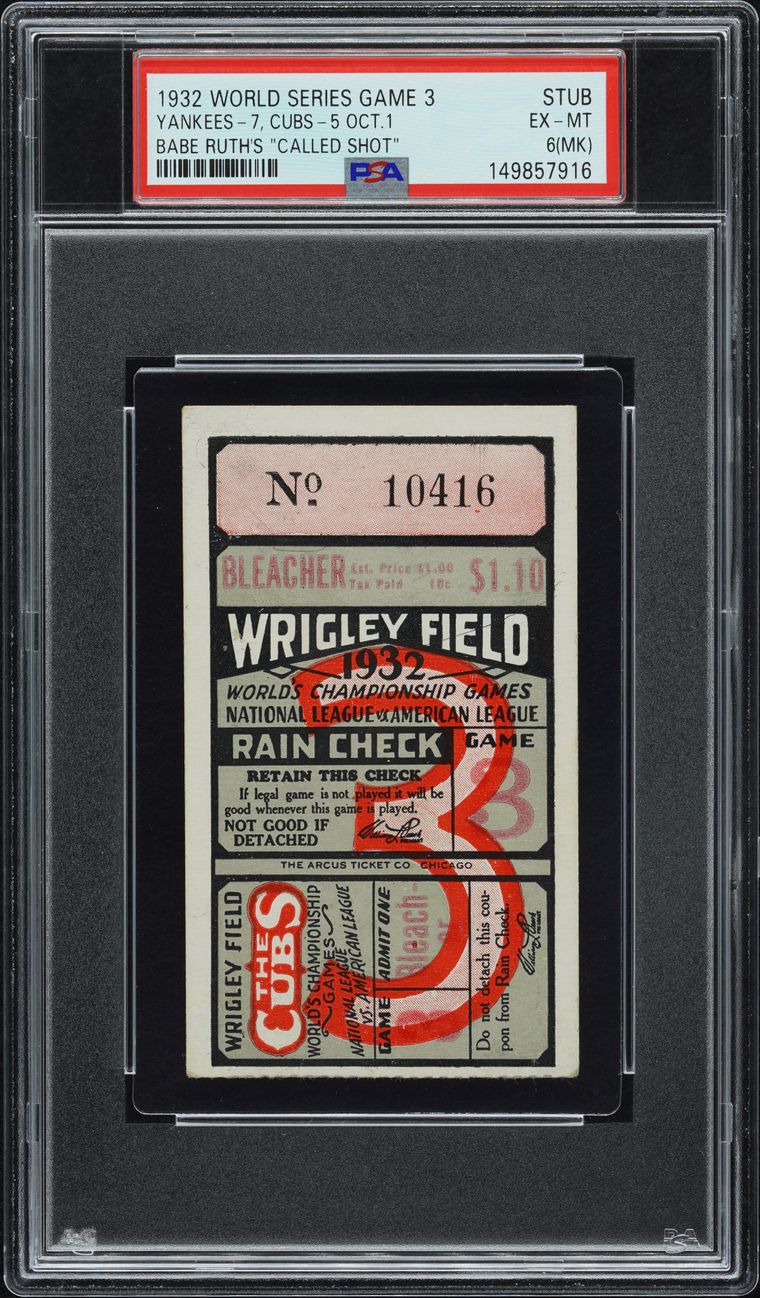
| 3 | Ticket1932 Babe Ruth's Called Shot, 141 stubs and 9 full | Graded150 | Sales used64 | Market cap$1,449,848 |
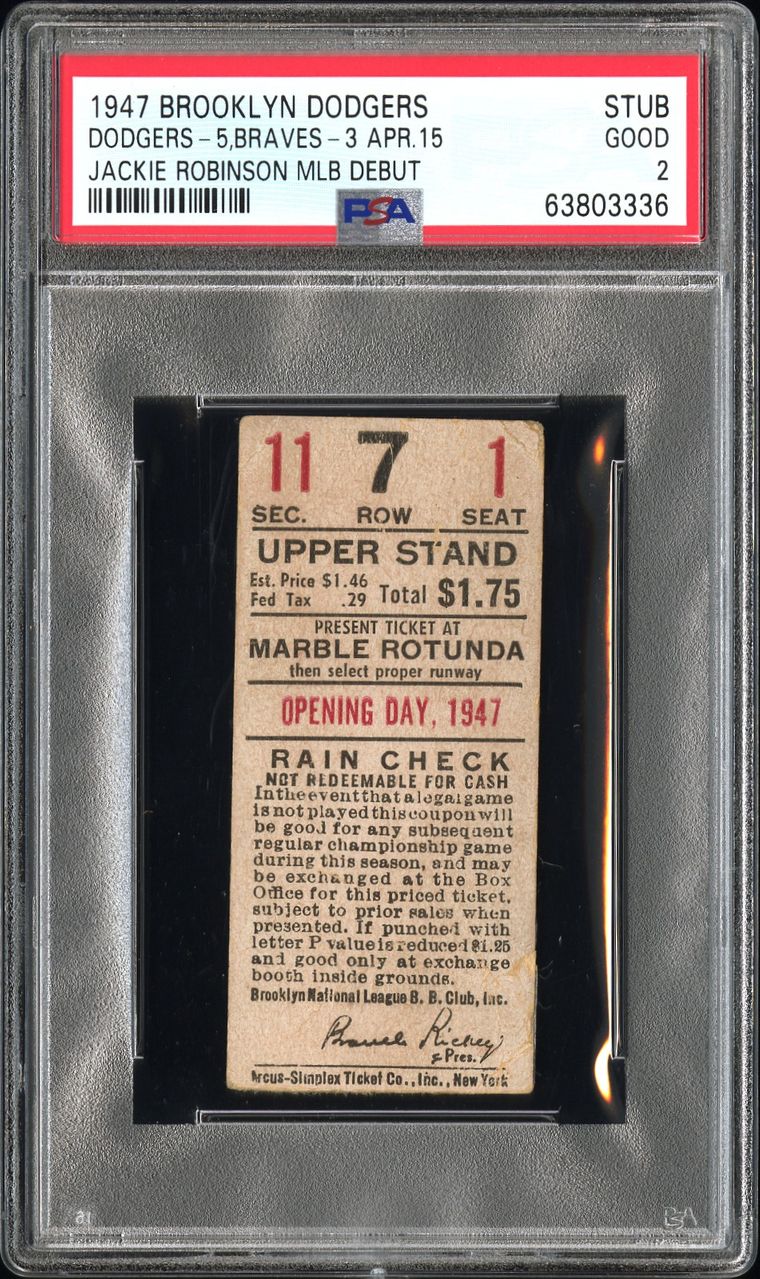
| 2 | Ticket1947 Jackie Robinson MLB debut, 14 stubs | Graded14 | Sales used7 | Market cap$3,202,920 |
Super Bowl I is fourth on 418 copies across three forms and 113 sales, the second-largest sales base on the list after Woodstock. Its 57 full tickets ($583,001) and 316 stubs ($554,458) are worth about the same in total, and the 43 passes add $43,386. LeBron James's debut is fifth on 192 copies. It is the one entry here where the full tickets are meaningfully under-priced by the method: 41 fulls have sold at only five grades, so under half of them are priced at a grade that has traded. A few more full-ticket sales would move it.
Number one, Michael Jordan's NBA debut at $4.27 million
Jordan's is not the scarcest ticket on the list, nor the dearest per copy: Robinson's debut is worth four times as much per copy on a fifth of the population. Jordan leads because it has both, a population of 79 and an average copy worth $54,106, and because the market has priced every rung of the ladder. Between them the top two are $7.48 million, 34% of the whole list.
The full ranking of the most valuable graded tickets
| # | Ticket | Graded | Sales | Market cap | Per copy | Direct |
|---|---|---|---|---|---|---|
| 1 | Ticket1984 Michael Jordan NBA debut | Graded79 | Sales40 | Market cap$4,274,337 | Per copy$54,106 | Direct100% |
| 2 | Ticket1947 Jackie Robinson MLB debut | Graded14 | Sales7 | Market cap$3,202,920 | Per copy$228,780 | Direct86% |
| 3 | Ticket1932 Babe Ruth's Called Shot | Graded150 | Sales64 | Market cap$1,449,848 | Per copy$9,666 | Direct97% |
| 4 | Ticket1967 Super Bowl I | Graded418 | Sales113 | Market cap$1,180,846 | Per copy$2,825 | Direct95% |
| 5 | Ticket2003 LeBron James NBA debut | Graded192 | Sales36 | Market cap$1,027,141 | Per copy$5,350 | Direct83% |
| 6 | Ticket1958 Pele World Cup debut | Graded124 | Sales57 | Market cap$996,755 | Per copy$8,038 | Direct90% |
| 7 | Ticket1969 Super Bowl III | Graded292 | Sales44 | Market cap$983,653 | Per copy$3,369 | Direct96% |
| 8 | Ticket1962 Wilt Chamberlain 100-point game | Graded29 | Sales23 | Market cap$972,469 | Per copy$33,533 | Direct93% |
| 9 | Ticket2000 Tom Brady NFL debut | Graded70 | Sales27 | Market cap$908,285 | Per copy$12,976 | Direct73% |
| 10 | Ticket1939 Lou Gehrig Day, the Luckiest Man speech | Graded10 | Sales8 | Market cap$800,500 | Per copy$80,050 | Direct90% |
| 11 | Ticket1951 Mickey Mantle MLB debut | Graded25 | Sales16 | Market cap$777,450 | Per copy$31,098 | Direct96% |
| 12 | Ticket1980 Miracle on Ice | Graded180 | Sales15 | Market cap$744,872 | Per copy$4,138 | Direct52% |
| 13 | Ticket1969 Woodstock | Graded3,020 | Sales416 | Market cap$690,742 | Per copy$229 | Direct98% |
| 14 | Ticket2001 Tom Brady enters for Drew Bledsoe | Graded179 | Sales24 | Market cap$568,309 | Per copy$3,175 | Direct91% |
| 15 | Ticket2016 Kobe Bryant scores 60 in his final game | Graded560 | Sales60 | Market cap$564,809 | Per copy$1,009 | Direct96% |
| 16 | Ticket1968 Super Bowl II | Graded240 | Sales47 | Market cap$557,980 | Per copy$2,325 | Direct97% |
| 17 | Ticket1956 Don Larsen perfect game | Graded373 | Sales57 | Market cap$555,023 | Per copy$1,488 | Direct95% |
| 18 | Ticket1996 Kobe Bryant NBA debut | Graded26 | Sales10 | Market cap$531,432 | Per copy$20,440 | Direct58% |
| 19 | Ticket1986 Super Bowl XX | Graded147 | Sales17 | Market cap$525,126 | Per copy$3,572 | Direct74% |
| 20 | Ticket1972 Roberto Clemente 3,000th hit | Graded63 | Sales18 | Market cap$504,222 | Per copy$8,004 | Direct78% |
What the twenty most valuable graded tickets have in common
Seven of the twenty are debuts: Jordan, Robinson, LeBron, Pele, Brady, Mantle and Kobe, eight if Brady's first NFL action in relief of Drew Bledsoe is counted. Four are Super Bowls, I, II, III and XX, and they are here for a different reason than the debuts: each is several hundred copies across stubs, fulls and passes, priced in the low thousands. Only one event was played outside the United States, Pele's debut in Gothenburg; the Miracle on Ice was in Lake Placid and Woodstock in Bethel, New York. The oldest is the 1932 Called Shot; the newest is Kobe's 2016 farewell, and only four of the twenty are from this century.
The spread in what one copy is worth runs from $229 (Woodstock) to $228,780 (Jackie Robinson), a factor of one thousand, and both tickets land within a few places of each other. That is the point of ranking by market cap rather than by record sale or by population alone: it is the one figure on which a ticket that 3,020 people kept and a ticket that 14 people kept can be compared. For the highest single prices ever paid, see the companion ranking of the biggest graded ticket sales, where Robinson's debut is first and Jordan's second.
Questions about the ranking
- What does market cap mean for a graded ticket?
- The census population of the ticket, grade by grade, multiplied by a price for each grade and summed. A grade with recorded sales is priced at the median of those sales; a grade with none is interpolated between the nearest sold grades and held flat beyond them. It is the value of the whole graded population at prices the market has paid, not what a single copy is worth.
- Why are signed tickets not used to price a grade?
- Because an autograph prices the signature, not the ticket. PSA grades the ticket and the autograph separately, so a PSA 1 stub with a GEM MT 10 signature is still a PSA 1 ticket. Signed copies are counted in the population, since they exist and are graded, but their sale prices are kept out of the curve that prices unsigned copies.
- Why only sales confirmed to a PSA cert?
- So that the grade is PSA's, read from the cert, and never a number parsed from an auction title. Title parsing lifts game numbers as grades, a "Game 7" ticket becoming a PSA 7. A sale we cannot place on a cert is left out rather than guessed.
- Why is a ticket I expected not on the list?
- Usually one of three reasons. It has fewer than five qualifying sales, or sales at only one grade, so its curve cannot be drawn (Wayne Gretzky's NHL debut, at $463,975, sits just outside on seven sales). Its population has not been censused yet, and a count we do not hold is not zero. Or its sales are all signed or multi-ticket lots, which do not qualify.
- How current are the figures?
- Population is PSA's census of 8 July 2026, the latest complete one. Sales run to 16 September 2026. The live ranking at collectorstools.com/rankings is rebuilt after every day's sales ingest and shows the per-grade ladder behind every figure.
Explore the data behind this report
Search every graded ticket sale, browse PSA population data, and track sold prices on Collectors Tools.