 Collectors Tools
How to value a graded ticket stub using population and sales data
Grade is one of four inputs, and on its own it is the weakest. Here is the method, worked end to end on a ticket where the same game produced sales from $600 to $23,180.
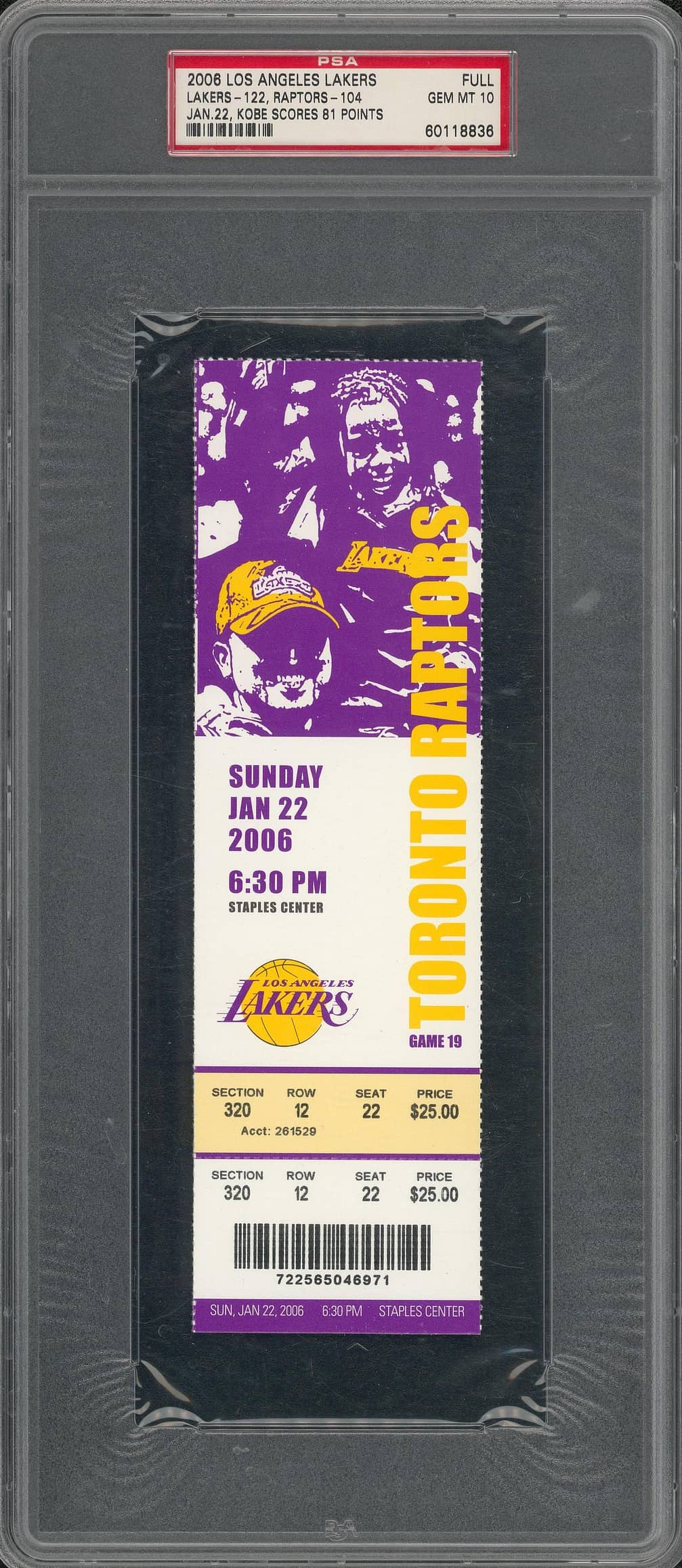
On 22 January 2006 Kobe Bryant scored 81 points against the Toronto Raptors. Full tickets from that game have sold, through the auction houses we track, for $600 and for $23,180. Both were full tickets. Both were graded by PSA. The $600 example was a PSA 3 and the $23,180 example was also a PSA 3.
That is not a pricing anomaly, and it is not a story about condition. It is what happens when three other variables move while the grade stays still. Anyone valuing a graded ticket by grade alone will be wrong by an order of magnitude on a regular basis. This is the method that gets it right, and the search that answers each step.
The four inputs that set the price
A graded ticket's value is a function of four things, in roughly descending order of how much they move the number:
| Input | The question it answers | Where to find it |
|---|---|---|
| Form | The question it answersIs this a full ticket, a stub, or a pass? Which PSA variety is it exactly? | Where to find itPopulation report |
| Population at grade | The question it answersHow many exist, and how many graded this high or higher? | Where to find itPopulation report |
| Signature | The question it answersIs it autographed, and did PSA/DNA grade the signature separately? | Where to find itTicket scans |
| Comparable sales | The question it answersWhat did the closest matches actually sell for, and when? | Where to find itAuctions and sales |
Grade sits inside the second of those, not above them. It matters, but it matters as a position on a population ladder rather than as a number in its own right. A PSA 5 out of ten known examples is a different asset from a PSA 5 out of two hundred.
Every lookup is a link
Each search on this site is a plain web address, so a specific question has a specific link that answers it. You do not have to search and then filter; you can go straight to the answer, and you can send that answer to someone else.
| To find | Open |
|---|---|
| One certification number | /scans?search=60118836 |
| Every graded example of a player or event | /scans?search=kobe+bryant |
| Only the autographed full tickets | /scans?search=kobe+bryant&stub=full&auto=1 |
| How many exist, by grade | /population?search=kobe+81+points |
| What they have sold for, highest first | /auctions?view=sold&q=kobe+81-point&sort=price_desc |
| Every graded example in one PSA set | /scans?heading_id=70589 |
Those six patterns cover most valuation work. The rest of this article walks the Kobe ticket through them in order.
Step one, identify the exact ticket
This is the step people skip, and it is the one that produced the $600-to-$23,180 spread. PSA does not catalogue "the ticket from the 81-point game". It catalogues two separate full-ticket varieties from that game, under different set identifiers, each with its own population count.
| PSA variety | Set id | Graded examples | Highest recorded sale |
|---|---|---|---|
| Los Angeles Lakers-Full | Set id70589 | Graded examples202 | Highest recorded sale$16,800 |
| L.A. Lakers/Box Office-Full | Set id193524 | Graded examples10 | Highest recorded sale$23,180 |
The box office variety is twenty times scarcer, and its best sale beats the standard variety's best sale despite the standard variety having sold far more often. A valuation that treats the two as one ticket is not slightly wrong, it is answering a different question. Search the population report first and confirm which row you are actually holding before you look at a single price.
Step two, read the population at your grade
Once the variety is fixed, the population report tells you where your grade sits in the surviving field. For the standard 81-point full ticket, PSA had graded 202 examples as of the 8 July 2026 capture, and the distribution is heavily weighted to the low end.
Two numbers matter more than the rest. One example has reached PSA 10, and 23 have reached PSA 7 or better, which is 11% of the graded field. Everything from PSA 2 to PSA 5 sits in a crowd of 116 tickets, more than half the population. That shape is normal for tickets that were torn and pocketed on the night, and it is why the price ladder in the next step is flat at the bottom and steep at the top.
Step three, find what comparable examples sold for
Now the sales. Below is every recorded sale of an unsigned standard-variety 81-point full ticket that we can tie to a specific certification number, twenty in total, spanning May 2020 to January 2026. Signed examples are excluded here deliberately, for reasons the next step makes obvious.
| Grade | Sales | Range | Median |
|---|---|---|---|
| PSA 10 | Sales1 | Range$4,500 | Median$4,500 |
| PSA 8 | Sales2 | Range$1,860 to $3,600 | Median$2,730 |
| PSA 7 | Sales1 | Range$2,160 | Median$2,160 |
| PSA 5 | Sales5 | Range$810 to $1,380 | Median$1,128 |
| PSA 4 | Sales4 | Range$720 to $1,440 | Median$1,041 |
| PSA 3 | Sales5 | Range$600 to $930 | Median$732 |
| PSA 2 | Sales2 | Range$750 to $1,320 | Median$1,035 |
Read down the median column and the shape of the ladder appears. Between PSA 2 and PSA 5 the medians sit within about $100 of each other, from $1,035 to $1,128, then the figure roughly doubles at PSA 8, to $2,730, and reaches $4,500 at the lone PSA 10. The money is concentrated at the top of the ladder, not spread evenly along it.
Be careful how much weight you put on the flat middle. Each of those medians rests on two to five sales spread across four years, so they are not a controlled comparison: given two copies of this exact ticket offered side by side today, the higher grade takes the higher price. What the numbers do show reliably is where the scarcity is. Grades 2 to 5 hold 116 of the 202 examples, so a buyer who misses one can wait for the next; only 23 examples have reached PSA 7 or better, and that is where the premium concentrates. Work out which side of that line your ticket sits on before you reach for a percentage.
Step four, separate the signed examples
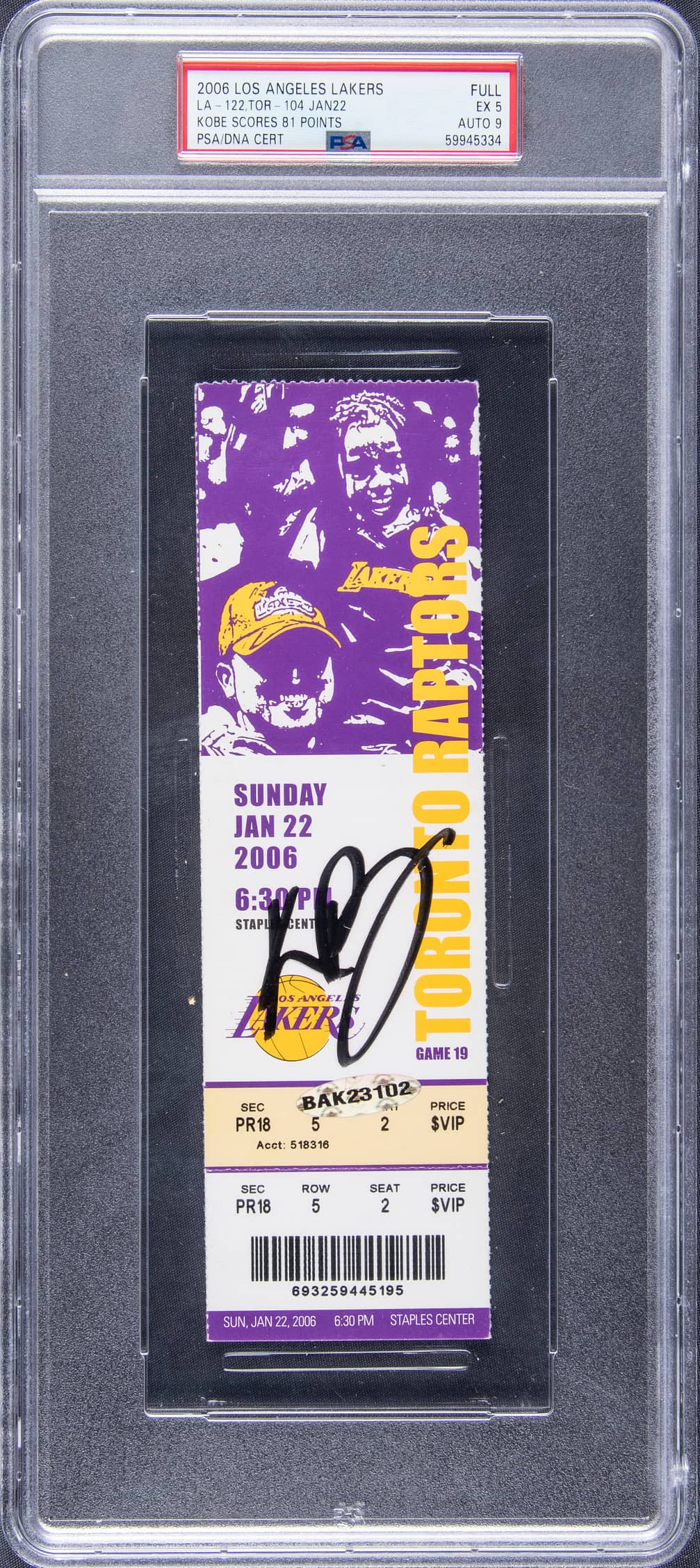
An autograph does not adjust the price, it replaces the pricing model. Every recorded signed sale of this ticket cleared every recorded unsigned sale, including the PSA 10.
| Sale | Ticket grade | Signature grade | Date |
|---|---|---|---|
| $16,800 | Ticket gradePSA 5 | Signature gradePSA/DNA MINT 9 | DateAug 2021 |
| $14,400 | Ticket gradeAuthentic | Signature gradePSA/DNA GEM MT 10 | DateJun 2022 |
| $9,760 | Ticket gradePSA 1 | Signature gradePSA/DNA MINT 9 | DateDec 2023 |
| $8,845 | Ticket gradePSA 1.5 | Signature gradePSA/DNA MINT 9 | DateMar 2024 |
| $7,320 | Ticket gradePSA 1 | Signature gradePSA/DNA NM-MT 8 | DateJan 2024 |
| $6,832 | Ticket gradePSA 1.5 | Signature gradePSA/DNA NM-MT 8 | DateDec 2023 |
A PSA 1 with a signature sold for $9,760. The best unsigned copy in existence sold for $4,500. Six signed sales, median $9,302, against twenty unsigned sales, median $1,029. On this ticket the signature is worth roughly nine times the ticket.
Putting the four steps together
Take an unsigned PSA 4 standard-variety 81-point full ticket. Step one fixes the variety at set 70589. Step two says 28 of the 202 graded examples are PSA 4, squarely in the crowd. Step three gives four comparable sales, $720 to $1,440, median $1,041, the most recent in January 2026. Step four confirms there is no signature, so the signed ladder does not apply. The answer is roughly $1,000, with real confidence, and every number behind it is checkable.
Change one variable and the method still works. Make it a box office variety and step one moves you to set 193524, where 10 examples exist and the comparable set is far thinner, so the answer widens and leans upward. Add a signature and step four moves you to a ladder starting near $6,800. The method does not change; the inputs do.
Look up any ticket's population
Type a name and results appear instantly. Groups with a View examples button open the real graded slabs at each grade, in place.
What sits behind these numbers
The figures in this guide come from three connected databases, all searchable above. As of 30 July 2026 they hold 84,967 individually graded tickets identified by certification number, 87,132 catalogue varieties across 37,708 PSA sets, 279,911 graded examples counted in the July 2026 population capture, and 17,589 settled graded-ticket sales alongside the lots currently open for bidding.
Population counts are captured on a dated schedule rather than estimated, so a figure quoted here is what PSA reported on a specific day and can be compared against the next capture. Sale prices are realised prices from the auction houses' own published results, and each one keeps its lot link, so any figure in this guide can be checked at source.
Common questions
- How do I find out how many of my ticket exist?
- Search the population report for the event, then match the exact variety text from your PSA label. The row gives the total PSA has graded and the count at each grade. Direct link pattern: /population?search=your+event. Two similar-looking rows are different catalogue items with separate populations, so match the wording rather than the game.
- What is my PSA certification number and where do I find it?
- It is the number printed on the red PSA label at the bottom right of the slab, usually eight or nine digits. It identifies that one specific graded ticket. Searching it returns the grade, the year, the event, the ticket form, the signature details if any, and the last recorded sale for that exact ticket. Direct link pattern: /scans?search=60118836.
- Is a full ticket worth more than a stub?
- Usually yes, and often by a large multiple, because a full ticket was never torn at the gate and far fewer survive. But the comparison only holds within the same event, and the two are catalogued separately by PSA, so compare a full against other fulls and a stub against other stubs. The population report shows each form's own count.
- Does a higher grade always mean a higher price?
- For a genuine like-for-like comparison, yes. The same ticket, same form, same signature status, higher grade wins every time. The catch is that comparisons are rarely like-for-like, and the differences that overturn the grade are often not spelled out on the label. An official ticket that admitted someone to the stadium outsells a commemorative. A ticket outsells a press or media pass. A full ticket can carry a lower grade than a stub of the same game and still be worth several times more. Establish that two examples are the same thing before you let the grade decide between them.
- Why do two graded copies of the same ticket sell for such different amounts?
- Usually because they are not the same ticket. PSA may catalogue a stadium ticket, a box office variant, a media pass and a commemorative under near-identical wording, and each has its own population and its own price level. Signature status is the other big one: a signed example is priced as an autograph rather than as a ticket, so it can clear an unsigned copy several grades above it. Sale date matters too, since two sales years apart are not a comparison. Match the variety, the form and the signature before comparing prices.
- How much does an autograph add to a graded ticket?
- Enough to change the pricing model rather than adjust it. On the 81-point full ticket, six signed sales ran from $6,832 to $16,800 with a median of $9,302, while twenty unsigned sales ran from $600 to $4,500 with a median of $1,029. Every signed example beat every unsigned one, including the only PSA 10. Compare signed against signed.
- Why does a listing say PSA 9 when the ticket is a PSA 1?
- Because the slab is dual-graded and the two numbers are different things. On a signed ticket PSA grades the ticket and PSA/DNA grades the signature separately, and both appear on the label. Listing titles often quote the higher of the two, which is usually the signature. Look the certification number up directly to see which grade belongs to which.
- How recent do comparable sales need to be?
- Prefer the last twelve to twenty-four months, and always check the date attached to each figure. Thinly traded tickets may have only a handful of sales spread over years, in which case use the full run and weight the recent ones, rather than treating a single old sale as the current price.
Explore the data behind this report
Search every graded ticket sale, browse PSA population data, and track sold prices on Collectors Tools.