 Collectors Tools
30 things you must know if you're collecting or investing in tickets
Fees, regrading, autographs and rookie cards. The second set of graded ticket questions, including three where the data contradicts what the hobby repeats.
Three things this hobby says with confidence do not survive our own records. A population of one does not command a premium, a GEM MT 10 autograph does not sell for more than a MINT 9, and the one superstar retirement we can measure pushed prices down, not up. Those answers are below alongside twenty-seven others, drawn from 17,610 tracked sales and the 279,911-ticket PSA population census, with the fee figures read from the auction houses' own published terms on 8 August 2026.
Fees, prices and the things that move them
Start with the cost almost nobody budgets for. The premium is quoted as a percentage, but both major houses apply a minimum fee per lot, and at the cheap end of the market that minimum is the entire story. Across 7,630 lots where we hold both the hammer price and the total, buyers paid $2,045,748 in premium on $9,721,401 of hammer.
| Hammer price | Lots | Average premium paid | Effective rate |
|---|---|---|---|
| Under $25 | Lots393 | Average premium paid$19 | Effective rate110.9% |
| $25 to $85 | Lots1055 | Average premium paid$19 | Effective rate36.8% |
| $86 to $499 | Lots3652 | Average premium paid$49 | Effective rate21.2% |
| $500 to $4,999 | Lots2145 | Average premium paid$300 | Effective rate20.9% |
| $5,000 and above | Lots386 | Average premium paid$3,094 | Effective rate20.8% |
- What does the buyer's premium actually cost me?
- Goldin charges 22% of the final bid, with a minimum of $19, plus a 3% fee if you pay by card, and Fanatics Collect adds 20% to the hammer price of all sales with a possible 2.9% payment fee. The percentage is not the trap, the minimum is: across the lots we hold hammer prices for, buyers bidding under $25 paid an effective 110.9%, because a $19 minimum on a $17 hammer more than doubles what you pay. Above roughly $86 the rate settles down to the low twenties and stays there. Worth knowing that Goldin's rate moved from 20% to 22% during 2023, so older sold prices were struck under a cheaper regime than the one you are bidding in now.
- Does paying up for a population of one make sense?
- Not on price alone, and the data is blunt about it: tickets from items with a population of one have a median sale of $212, against $408 for items with 26 or more graded. Scarcity is not what people are paying for, fame is, and the highest-population tickets are high-population precisely because they are famous moments lots of people kept. The other risk is that a population of one is not a permanent condition. Tickets were used by ordinary people and turn up in ordinary places, so a family clearing out a house can find four in a programme and put them all on the market at once, which is exactly what happened with the Jordan debut: certificates 111581484 to 111581487 are consecutive, meaning one submission, and they graded 8, 8, 4 and 6. Willie Mays is the cautionary version, with his third MLB game still sitting at population one in our census and material that thin only ever being one discovery away from doubling.
- Do full tickets appreciate faster than stubs?
- They sell for more, but they do not grow faster, and those are different claims. Following the same certificate from one sale to the next, fulls came back 13% below what the seller paid and stubs 15% below, across 407 and 335 resales, which is the same number given the sample. The reason to buy the full is still sound, because a full can always become a stub and never the other way round, so you are holding the version that keeps every option open.
- Which grade is the sweet spot?
- It has moved. When populations were tiny and nobody could be choosy, owning the moment at any grade was the whole game, but as card collectors arrive they have brought a grade-first mentality with them, and the top of the market now goes to the top of the grade scale. On modern tickets that is a realistic target rather than a fantasy: 32.9% of tickets from 2020s events grade PSA 10, against 7.5% from the 2000s and 1.8% from the 1980s. For anything vintage the sweet spot is still the moment, because the 10 you want mostly does not exist.
- How often does a ticket fail to sell?
- Rarely, if it is genuinely good. Of the auction listings we have followed to a conclusion, 482 sold against 189 that ended unsold, and that is a small sample rather than a market-wide rate. The practical answer is that a good ticket is close to guaranteed to sell, and the only real question is what it makes on the day.
- Do bid counts tell you anything about the final price?
- They track it closely: lots taking 1 to 4 bids have a median of $150, 5 to 14 bids $240, 15 to 29 bids $445, and 30 or more bids $863. But that is desirable lots attracting bidders rather than bidding creating value, and the mechanism at the top is much simpler than the chart suggests, because two determined people are all it takes to set a record. Bid counts before 2022 are not reliable enough to use.
- When are the big auctions, and does timing matter?
- Yes, because the best material is deliberately concentrated. The Goldin 100 gathers the hundred items they judge the strongest, and both major houses run curated themed sales, with the World Cup getting two of them, one before the tournament and one after. If your ticket fits a themed sale it belongs in that sale, since a curated auction brings the audience to you rather than leaving you to find it in a weekly.
- Does a player retiring push prices up?
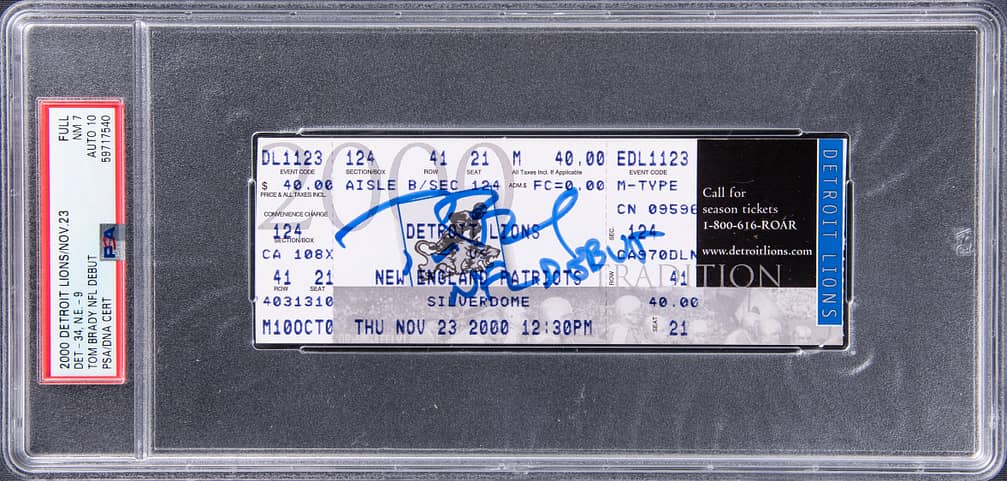
- The one case we can actually measure says no. Tom Brady retired in February 2023, and his median sale went from $1,860 before to $930 after, a 50% fall, while the market as a whole moved from $408 to $281 over the same two windows, a 31% fall. So he fell harder than everything around him. The honest caveat is that his "before" window contains the February 2022 peak and his record signed debut tickets, so the comparison flatters the decline, and no genuine all-time great has retired in a calm market during the five years tickets have been rising. Treat the retirement bump as unproven rather than disproven.
- Is there money in buying a ticket to regrade?
- Sometimes, because PSA has loosened on old material. Holding the event decade constant and splitting by when the ticket was submitted, tickets from the 1960s graded 9 or 10 9.4% of the time in earlier submissions and 18.7% in later ones, with the 1970s going 3.3% to 7.9%. Vintage tickets graded years ago under harsher standards are the pool worth looking at. Tickets also carry seat and section numbers, so unlike a card you can usually prove a regraded ticket is the same physical object as the one that held the lower grade.
- Does the autograph grade change what a signed ticket sells for?
- No, which surprises people who chase the 10. Median sale by autograph grade runs $661 for a GEM MT 10, $690 for a MINT 9 and $824 for an NM-MT 8, so if anything the relationship points the wrong way, and the differences are noise. The market is paying for whose signature it is and what the ticket is, not how cleanly the pen moved. That said, collectors do talk about a 9 as a weak autograph, so the perception is real even though the price is not.
Grading, autographs and handling your own tickets
A modern ticket and a vintage ticket are not playing the same game. The share of each era's tickets that reach a PSA 10 climbs steeply as the events get more recent, which is why a 10 is a sensible target on something printed this decade and close to unreachable on something torn at a turnstile in 1975.
- What is a dual-graded slab, and which of the two grades matters?
- A dual-graded slab carries two separate grades, one for the ticket and one for the autograph on it, and we hold 13,112 of them. In practice the autograph grade matters less than people assume, partly because it is not priced (see the autograph-grade answer above) and partly because a 10 is the normal outcome rather than an achievement: of the certificates carrying a real autograph grade, 7,280 are GEM MT 10 against 2,010 at MINT 9 and 711 at NM-MT 8. What it does mean is that a lot titled "PSA 10" might be describing the signature while the ticket underneath is an Authentic, so read which number belongs to which.
- Is it worth cracking a slab and resubmitting?
- It depends almost entirely on when the ticket was originally graded. PSA used to assess tickets the way they assess cards, which was unduly harsh on objects that were designed to be torn, and they have since become more sensible about it. As a rough guide, certificate numbers below roughly 75 million belong to that harsher era and are the ones worth a second look, and the regrade data above backs that up for vintage material.
- What do the qualifiers mean, MK, OC and the rest?
- MK is a mark, usually pen. OC is off-centre, meaning the ticket was printed off-centre. ST is a stain. In practice you will only ever meet the first one: across our scan records there are 2,761 MK certificates and exactly two OC and two ST. A marked ticket can still grade well, up to a ceiling, and no 10 with an MK qualifier exists in our records.
- What is the difference between a PSA grade and PSA/DNA?
- PSA grades the ticket, PSA/DNA authenticates and grades the autograph on it. They appear on the same slab and are two independent judgements, which is the whole reason dual-graded tickets exist and the reason auction titles quoting a single number can mislead.
- Whose signature appears on the most graded tickets?
- Stephen Curry, ahead of Tom Brady, Lionel Messi and Nolan Ryan. It is a modern list because signing a ticket requires physically getting it in front of the person, so signed tickets cluster around players who were accessible during the era when ticket collecting took off, not around the biggest names in history.
- Does getting a ticket signed hurt its grade?
- Generally not. PSA will not usually mark a ticket down for the signature itself, though if the pen has pressed hard enough to dent the ticket that damage is real and will be judged like any other. Anything that happens to the ticket in the process, a fold or a crease from handling it at a signing, affects the ticket grade and leaves the autograph grade untouched, since the two are assessed separately.
- Are souvenir, commemorative and phantom tickets worth anything?
- Very little, and PSA labels them so you can tell. A commemorative or souvenir ticket is marked COMM in the same place the label would otherwise read full, stub or pass. Proofs and phantoms sit in the same category, and the census holds 599 proof headings and 203 phantom against more than 16,000 each of full and stub. The principle is simple: value follows the tickets that actually admitted somebody to the event.
- Several tickets exist from the same game. Which one is valuable?
- The one that got somebody through the gate and was printed before anybody knew what would happen. A general admission or season ticket version valid for entry to that specific game is the one to want, and increasingly the printing time on the ticket is itself part of the evidence, since it proves the ticket existed before the moment it now commemorates.
- How do I actually sell a collection?
- Goldin and Heritage are the two realistic routes for anything of consequence, and between them they account for 96% of the money in this market. Goldin will also handle the grading for you as part of consigning, which removes a step if your material is raw. Anything low-value is better sold in a group lot than individually, because a $19 minimum premium makes cheap single lots painful for the buyer and that comes out of your hammer.
- How should I store tickets that are not graded yet?
- A sleeve big enough for the ticket, then that sleeve inside a top loader. Nobody makes a top loader sized specifically for tickets yet, so the usual workarounds are banknote top loaders or photograph top loaders, both of which are cheap and easy to find. The aim is simply to stop new creases forming, because a fold is the single most expensive thing that can happen to a ticket.
How this market really behaves
The comparison collectors arriving from cards always want is the rookie card against the debut ticket. It does not resolve the way either side expects, because the answer changes completely depending on which player you pick.
| Player | Rookie card, top grade | Card sale | Debut ticket sale |
|---|---|---|---|
| Michael Jordan | Rookie card, top grade1984 Star #101, no PSA 10 exists | Card saleOver $1M (PSA 9, private) | Debut ticket sale$468,000 |
| Lionel Messi | Rookie card, top grade2004-05 Megacracks #71bis, 19 PSA 10s | Card sale$1.5M (PSA 10) | Debut ticket sale$49,200 |
| LeBron James | Rookie card, top grade2003 Topps #221 PSA 10 | Card saleAbout $6,000 to $8,500 | Debut ticket sale$40,800 |
Jordan's Star card behaves exactly like a ticket, with zero PSA 10s in a population of 522 and only eight examples above a PSA 8, so the condition ceiling people treat as a ticket problem is really an old-object problem. And a LeBron debut ticket sells for roughly five times his base rookie card.
- What share of graded tickets ever come to market?
- About one in twenty. We have tracked 14,876 distinct certificates selling publicly, against a population of 279,911, which is 5.3%. The other 95% has never traded anywhere we can see it, which is worth remembering every time someone quotes a price as though it were a market rate rather than the last time one of a very small number of examples happened to move.
- Is an auction house's Pop 1 claim usually true?
- Usually true in a narrow sense and misleading in the way most buyers read it. Of 1,263 lots claiming Pop 1, 742 of the checkable ones genuinely are the only example at that grade, but only 316 are the only example of the ticket full stop, and the average lot advertised as Pop 1 comes from an item with 12 graded examples. The industry uses the phrase to mean pop 1 at that grade, so a PSA 8 can be called a Pop 1 while five PSA 9s exist above it. When collectors say the population report, they mean the whole report for that ticket in that form.
- Is the rookie card or the debut ticket the better object?
- It depends entirely on the player, and the spread is enormous. A Messi PSA 10 rookie sold for $1.5M against $49,200 for his Barcelona debut full ticket, so there the card wins by thirty times. Reverse it for LeBron, whose base 2003 Topps rookie sits around $6,000 to $8,500 in a PSA 10 while his debut full ticket made $40,800. The honest footnote is that LeBron's premium rookies sell for millions, so the comparison is to that specific card rather than to everything he appears on.
- Why does a debut ticket almost never come in a PSA 10?
- Because the ticket had to be used to be authentic, and being used means being torn and pocketed. Across the debut varieties for the three most-compared players, PSA 10s make up about 1% of what exists: three of 122 for Jordan, three of 432 for Messi, two of 310 for LeBron. A card came off a press and into a sleeve, while a ticket came out of somebody's coat.
- How often does the same ticket come back to market?
- More often than the scarcity suggests. Across 828 resales we can follow certificate by certificate, the median gap between sales is 463 days, and 41% of them return within a single year. So a ticket you miss is not necessarily gone for a decade, though the specific one you want may well be.
- Do high grades change hands more often than low ones?
- No, and the flatness is the finding. The mix of grades that sells is almost exactly the mix of grades that exists, with PSA 9 making up 9.6% of the population and 9.6% of sales. Liquidity is grade-neutral even though price is increasingly not, so a high grade will get you more money rather than a faster sale.
- How many graded tickets are autographed?
- About one in six, or 13,697 of the 86,187 certificates we hold detailed records for. Every one of those is signed directly on the ticket in person, since there is no such thing as a factory-inserted ticket autograph, which is the structural advantage tickets have over the sticker autographs common in cards.
- Does the market care about football, or is it all American sport?
- Both, differently. Football (soccer) sells fewer tickets at higher prices, with a median of $472 across the lots we can identify, while American football sells far more volume at a lower median of $372 and moves about two and a half times as much total money. So the football community is real and pays up per ticket, while American sport is simply bigger. These are keyword-identified rather than exhaustively catalogued, so read them as indicative.
- How many graded tickets survive from before 1900?
- 734 tickets across 255 headings, which is a quarter of one percent of everything PSA has graded. That is the genuinely deep end of this hobby, and the survival rate is what makes the nineteenth-century material feel different in the hand to anything from the modern era.
- Which auction house sells the most graded tickets?
- Goldin sells the most tickets and Heritage sells the most value. Goldin has 7,643 tracked sales to Heritage's 6,602, but Heritage accounts for $18.2M against Goldin's $11.8M, which is 58.4% of all the money in the market. Fanatics Collect runs a high volume of lower-value lots, 3,364 sales for 3.9% of the value. If you are buying, the cheaper material is where Fanatics lives; if you are selling something serious, the top end has consistently been Heritage.
The thread running through the awkward answers is the same one: this market prices recognition, not rarity. A population of one sells for half what a population of 26 sells for, a perfect autograph grade adds nothing, and 95% of everything ever graded has never publicly traded at all.
Explore the data behind this report
Search every graded ticket sale, browse PSA population data, and track sold prices on Collectors Tools.