 Collectors Tools
Why the most valuable graded ticket we track is only a PSA 2
The most expensive ticket in our data is a battered PSA 2. That is not a fluke, it is how the market works. Across 73,843 graded tickets and more than 17,000 sales, the grade barely sets the price, lower grades often sell for more, and only a gem-mint 10 earns a real premium. Graded tickets break the card-collecting rulebook.
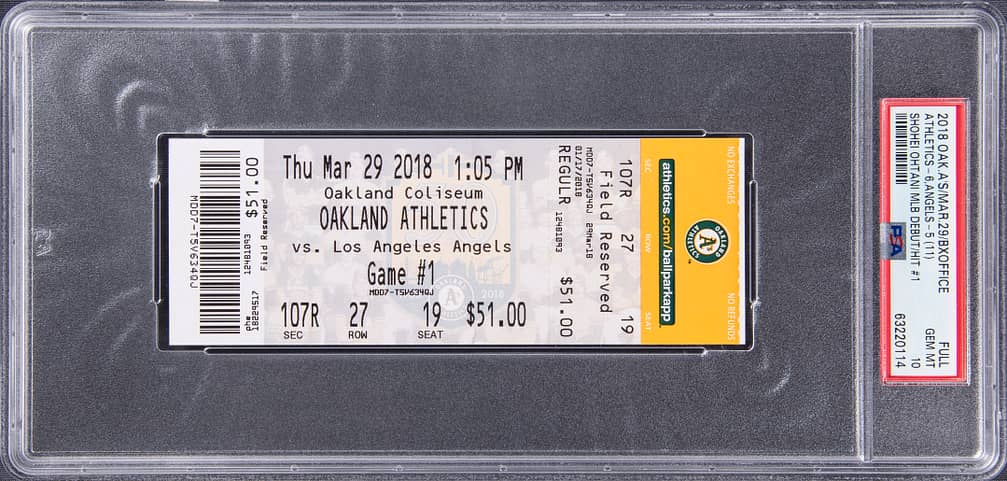
The single most expensive graded ticket we track is a 1947 Jackie Robinson debut stub graded PSA 2, the second-lowest numeric grade PSA gives, which sold for $480,000. The second most expensive is the same ticket in PSA 3, at $366,000. In trading cards that would be impossible: condition is the price. For graded tickets it is almost beside the point. We ran the full picture, every graded ticket in our database and every sale we have tracked, and the same answer kept coming back: the grade barely sets the price.
The data: 73,843 PSA-graded tickets we track for condition, and 17,161 individual (non-bulk) sales worth $29M across Goldin, Heritage and Fanatics Collect, 2013 to 2026. Prices are realised results. Grade figures use the PSA numeric grade on each slab; sale figures exclude bulk lots so one price means one ticket. You can open any cert on the ticket scan database and check the comparables on population.
Tickets grade like nothing else in the hobby
Start with condition, because it explains everything after it. Cards mostly grade high: the modern hobby is built on PSA 9s and 10s. Tickets do the opposite. The median graded ticket is a PSA 5, the mean is 4.8, and only 5.4% ever reach PSA 10. More telling is the shape: graded tickets are spread almost evenly across every grade from Authentic to 8, each holding roughly a tenth of the population. There is no fat top end. A ticket was folded, torn at the gate, shoved in a pocket and kept in a drawer for decades, so it survives in whatever state it survived in.
The grade is mostly a clock
A ticket's grade tracks its age more than anything a buyer is paying for. The older the event, the lower the grade, almost without exception. Pre-1960 tickets have a median grade of PSA 2 and produce a PSA 10 just 0.1% of the time. Move forward and it climbs steadily, until 2020s tickets sit at a median PSA 8 and hit a 10 a quarter of the time. A modern printed-on-cardstock ticket pulled straight from a will-call envelope can be flawless; a 90-year-old paper stub cannot.
| Era of event | Tickets | Reach PSA 10 | Median grade |
|---|---|---|---|
| Pre-1960 | Tickets7,196 | Reach PSA 100.1% | Median gradePSA 2 |
| 1960s | Tickets5,169 | Reach PSA 104.3% | Median gradePSA 4 |
| 1970s | Tickets5,000 | Reach PSA 100.6% | Median gradePSA 4 |
| 1980s | Tickets7,546 | Reach PSA 100.9% | Median gradePSA 4 |
| 1990s | Tickets10,773 | Reach PSA 102.3% | Median gradePSA 4 |
| 2000s | Tickets10,928 | Reach PSA 103.1% | Median gradePSA 5 |
| 2010s | Tickets11,538 | Reach PSA 1012.2% | Median gradePSA 8 |
| 2020s | Tickets4,215 | Reach PSA 1025.1% | Median gradePSA 8 |
The same clock runs inside a single ticket, between the full ticket and the torn-off stub. Full tickets, the ones never handed over at the gate, carry a median grade of PSA 7 and reach a 10 nearly one time in ten. Stubs, which were ripped and pocketed by design, sit at a median PSA 3 and reach a 10 only 0.3% of the time. Condition was decided the day the ticket was used, not in the grading room.
Which is why lower grades sell for more
Here is where tickets stop behaving like cards entirely. Line up the median sale price at each grade and it runs backwards: a PSA 10 sells for a $300 median, a PSA 8 for $210, while a PSA 2 sells for $360 and a PSA 1 for $366. The worse the grade, the higher the typical price. It is not magic, it is the clock again: the low grades are where all the old, historic, scarce tickets live, and a 1947 Robinson stub at PSA 2 is worth a fortune precisely because no clean one could exist.
Hold the ticket fixed, and only the 10 pays
The inverted curve is a composition effect, so we controlled for it: take one event at a time (132 tickets with sales at multiple grades) and ask what each grade is worth relative to that exact ticket's own median. The result is the real surprise. From Authentic all the way to PSA 9, the grade barely matters, every grade trades within a hair of the event median (0.9x to 1.0x). The only grade that pays a premium is the PSA 10, at 1.57x. Even head to head, when two grades of the same ticket both sell, the higher grade wins only 63% of the time, barely better than a coin flip.
So the gem-mint 10 is the one grade worth chasing, and it is rare for a reason: as the era table showed, almost the only tickets that get there are modern. The Ohtani debut full ticket in the hero image is exactly that, a PSA 10 because it is recent enough to be one. For everything older, stop reading the grade as a price and read it as a condition note.
What actually sets the price
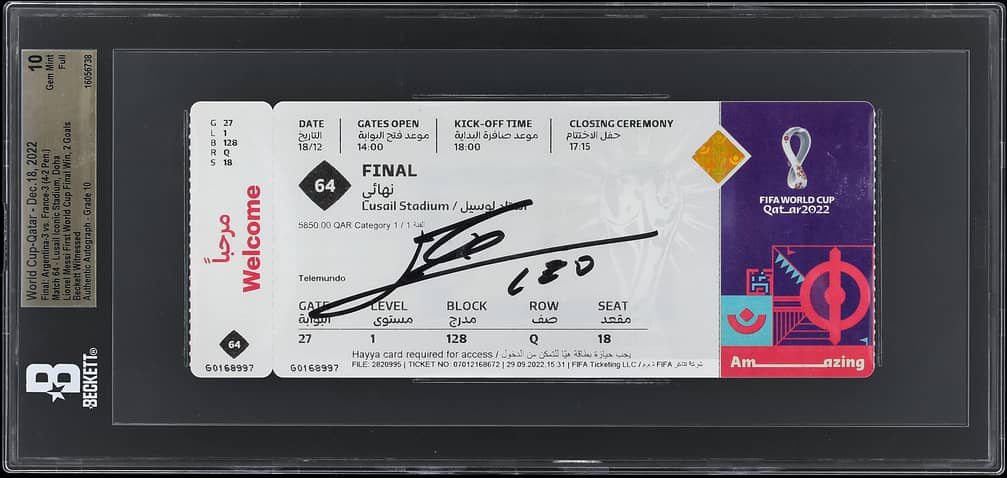
If not the grade, then what? Two things. First, the event, by a mile. Sort sales by sport and the medians fan out from $408 for boxing to $1,980 for golf, and golf only sits on top because of one ticket: Tiger Woods' 1996 professional debut, whose full ticket has sold as high as $99,000. Baseball is the most-graded sport (26% of all tickets) but a middle-of-the-pack $468 median. The graded-ticket world is wide, but the money pools around a handful of debuts and milestones.
| Sport | Sales | Median price |
|---|---|---|
| Golf | Sales84 | Median price$1,980 |
| Soccer | Sales96 | Median price$825 |
| Hockey | Sales108 | Median price$604 |
| Basketball | Sales973 | Median price$576 |
| Football | Sales1,268 | Median price$479 |
| Baseball | Sales2,525 | Median price$468 |
| Boxing | Sales458 | Median price$408 |
Where graded tickets trade
The three houses we aggregate are not interchangeable, they occupy different ends of the market. Heritage is the premium room: the highest median ($482), the most total value ($16.1M), and the record lots, including the $480,000 Robinson. Goldin runs the broad middle, the most sales and a $317 median. Fanatics Collect is the high-volume floor, a $110 median, where the everyday graded ticket changes hands. Where a ticket sells tells you roughly what tier it is before you see the price.
| House | Sales | Median | Total | Record lot |
|---|---|---|---|---|
| Heritage | Sales6,079 | Median$482 | Total$16.1M | Record lotRobinson debut PSA 2, $480k |
| Goldin | Sales7,724 | Median$317 | Total$11.7M | Record lotRobinson debut PSA 3, $366k |
| Fanatics | Sales3,357 | Median$110 | Total$1.2M | Record lotTiger Woods debut, $31k |
Put it together and graded tickets run on their own rulebook. They grade low because they were used; the grade tracks age, not desirability; so the price curve inverts, with the vintage low grades on top; and holding the ticket fixed, only the PSA 10 earns a premium while every grade beneath it sells for about the same. What you actually pay for is the event and the autograph, priced at the house that matches the tier. The most expensive ticket we track being a PSA 2 is not a quirk in the data. It is the data.
Explore the data behind this report
Search every graded ticket sale, browse PSA population data, and track sold prices on Collectors Tools.